01 Read
What happened
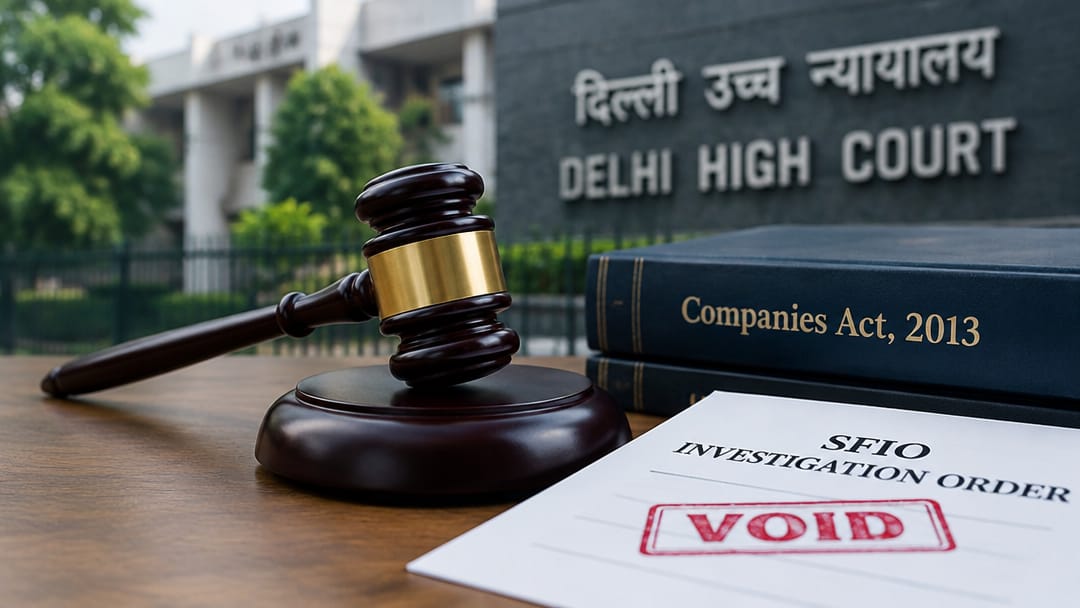
Justice Sachin Datta of the Delhi High Court struck down an SFIO investigation order issued under Section 212 of the Companies Act, 2013, holding it legally unsustainable. The court ruled that ordering an SFIO investigation is a serious statutory measure with substantial consequences for companies and individuals, and cannot be mechanically issued. The government must demonstrate genuine application of mind before directing the SFIO to investigate alleged corporate fraud.
02 Understand
Why it matters
Section 212 of the Companies Act, 2013 empowers the Central Government to assign investigation of a company's affairs to the Serious Fraud Investigation Office (SFIO) when it believes that the business of the company is being or has been conducted in a fraudulent or unlawful manner. Once an SFIO investigation is ordered, it carries serious consequences: directors can be arrested without bail under Section 212(8), and the SFIO Inspector's report is treated as a police report under the CrPC.
The Delhi HC ruling introduces a critical procedural safeguard: the order directing investigation must reflect genuine application of mind by the government authority. A mechanical or routine order — one that simply invokes the statutory language without engaging with the specific facts of the case — will not survive judicial scrutiny. This is consistent with the broader administrative law principle that statutory powers carrying penal or quasi-penal consequences demand reasoned, individualized exercise.
For CLAT PG aspirants, the significance is threefold. First, it reinforces that Section 212 powers are not absolute — they carry a reasonableness threshold. Second, it connects to the Supreme Court's earlier ruling in SFIO v. Rahul Modi, which addressed the time-period interpretation for SFIO investigations. Third, it clarifies that judicial review of SFIO orders is available, limiting the government's discretion under a statute that otherwise confers sweeping investigative authority. The examiner will test whether aspirants can distinguish between the power to order an investigation and the conditions that make that order legally valid.
Remember + Why it matters
The key recall facts and exact examiner angle for CLAT PG are in the Crux app.
01
Key figure and date from this topic
02
Specific number or threshold to remember
03
Policy or regulatory implication
Read + Understand free forever · 30-day free trial