01 Read
What happened
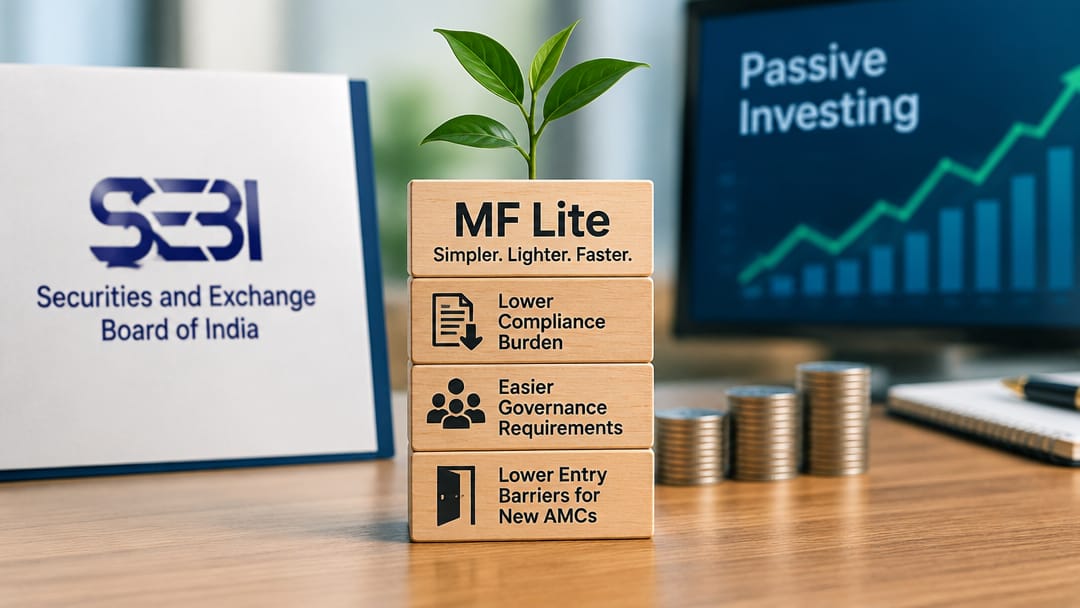
SEBI introduced the Mutual Fund Lite (MF Lite) framework to create a separate, simplified regulatory route exclusively for passive mutual fund schemes such as index funds and ETFs. The framework reduces compliance burdens, eases governance requirements, and lowers entry barriers for new asset management companies wanting to operate only passive schemes. Active fund sponsors remain under the existing, stricter MF regulations. The move is intended to deepen participation in India's passive investing market by reducing operational costs and regulatory overhead for passive-only AMCs.
02 Understand
Why it matters
Passive mutual funds — primarily index funds and Exchange Traded Funds (ETFs) — replicate a benchmark index rather than relying on active fund manager decisions. Because the investment universe is pre-defined by the index, their risk profile, decision-making complexity, and potential for manager-driven misconduct are structurally lower than active funds. SEBI's MF Lite framework recognises this distinction and creates a proportionate regulatory regime.
Key relaxations under MF Lite include reduced net worth requirements for sponsors, simplified scheme information documents (SIDs), lighter trustee and board governance obligations, and streamlined compliance reporting. Critically, only entities offering exclusively passive schemes — index funds, ETFs, Fund of Funds investing in ETFs — qualify for MF Lite registration. Any AMC wishing to launch active schemes must register under the full MF Regulations.
This is consistent with SEBI's broader principle of risk-proportionate regulation: the stricter the product's complexity and discretion, the heavier the regulatory overhead. MF Lite also lowers barriers to entry, potentially encouraging new specialised passive-only AMCs, which could increase competition and reduce expense ratios for retail investors.
From an exam perspective, this framework is directly connected to SEBI's 2024 initiative to simplify SIDs (Scheme Information Documents) — a topic already tested in SEBI Grade A 2024. MF Lite builds on that reform direction, making the definitional boundaries (passive vs. active, MF Lite vs. full MF Regulations) prime MCQ territory.
Remember + Why it matters
The key recall facts and exact examiner angle for SEBI Grade A are in the Crux app.
01
Key figure and date from this topic
02
Specific number or threshold to remember
03
Policy or regulatory implication
Read + Understand free forever · 30-day free trial