01 Read
What happened
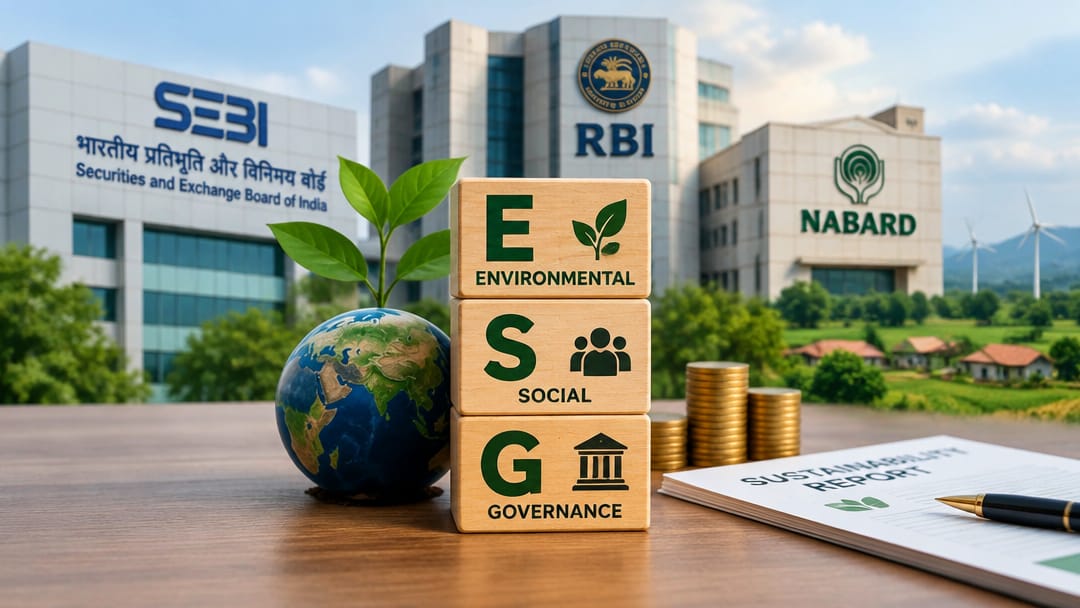
ESG — Environmental, Social, and Governance — is a framework that measures how companies manage climate risk, social responsibility, and board accountability. In India, SEBI mandates Business Responsibility and Sustainability Reporting for top-listed firms, RBI has issued a Discussion Paper on climate risk, and NABARD channels green credit for rural ecology. Globally, ESG ratings now influence sovereign and corporate borrowing costs, making it central to financial regulation and India's net-zero commitments under the Paris Agreement.
02 Understand
Why it matters
ESG is not merely a corporate buzzword — it is a structured risk-assessment and disclosure framework that regulators worldwide are converting into binding obligations.
**Environmental (E):** Covers carbon emissions, water use, biodiversity impact, and climate transition risk. For banks, the RBI has flagged physical risk (floods, droughts damaging loan collateral) and transition risk (stranded fossil-fuel assets) as material credit risks.
**Social (S):** Covers labour rights, supply-chain standards, community impact, and financial inclusion. NABARD's priority-sector lending and watershed programmes are evaluated against social ESG metrics.
**Governance (G):** Covers board composition, executive pay, audit independence, and anti-corruption. SEBI's Listing Obligations and Disclosure Requirements (LODR) embed governance norms for listed companies.
**India-specific architecture:**
- SEBI introduced Business Responsibility and Sustainability Report (BRSR) mandatory for the top 1,000 listed companies by market capitalisation from FY 2022–23.
- BRSR Core (assurance-backed) became mandatory for the top 150 listed entities from FY 2023–24.
- RBI released a Discussion Paper on Climate Risk and Sustainable Finance (2023), proposing scenario analysis and stress-testing for banks.
- NABARD issues Green Bonds and supports climate-resilient agriculture under the National Adaptation Fund for Climate Change (NAFCC).
- India's NDC under the Paris Agreement targets 50% cumulative electric power from non-fossil sources by 2030, directly driving ESG-aligned investment flows.
ESG connects to three exam pillars: climate policy (UPSC), financial regulation and green finance (RBI), and rural credit and ecology (NABARD).
Remember + Why it matters
The key recall facts and exact examiner angle for SEBI Grade A are in the Crux app.
01
Key figure and date from this topic
02
Specific number or threshold to remember
03
Policy or regulatory implication
Read + Understand free forever · 30-day free trial