01 Read
What happened
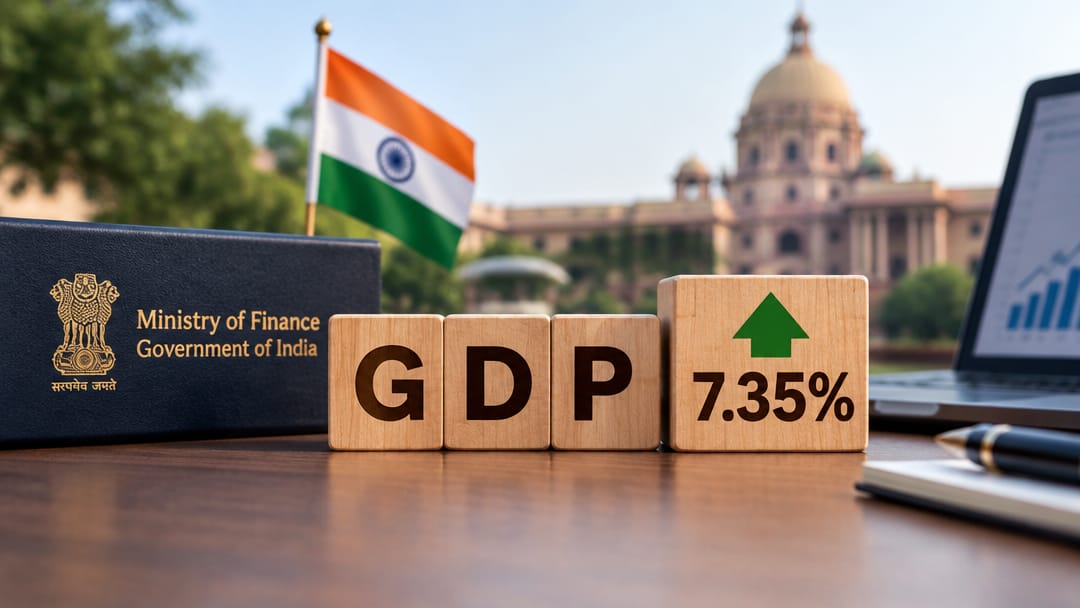
India's Ministry of Finance, using its nowcasting model, estimates GDP growth at 7.35 per cent for the second quarter of FY27 (July–September 2026), according to its monthly economic report. The projection signals continued resilience but is accompanied by acknowledged downside risks. Nowcasting differs from official GDP estimates by using high-frequency real-time indicators to generate forward-looking growth readings before formal data is released by the National Statistical Office.
02 Understand
Why it matters
A nowcasting model uses high-frequency, real-time data — such as GST collections, PMI readings, power consumption, rail freight, and credit offtake — to estimate GDP growth before the National Statistical Office publishes official quarterly figures. This is important because official GDP data arrives with a lag of roughly two months after the quarter ends, creating a window during which policymakers and analysts rely on such proxies.
The Finance Ministry's Monthly Economic Review is the vehicle for this estimate. When it projects 7.35% for Q2 FY27, it is drawing on contemporaneous indicators rather than a structural model alone.
For exam purposes, understand three distinctions: (1) Nowcasting vs. forecasting — nowcasting uses current-period data to estimate the present, while forecasting projects future periods; (2) NSO vs. Ministry of Finance — the NSO publishes the Advance Estimate, First Revised Estimate, and Second Revised Estimate, while the Finance Ministry's nowcast is an independent real-time tool; (3) India's GDP measurement uses the expenditure method (C+I+G+NX) and the production/value-added method, with the base year currently 2011-12.
The 7.35% figure, if realised, would place India comfortably among the fastest-growing major economies, consistent with IMF and RBI projections for FY27. The caveat of 'risks' typically refers to global trade uncertainty, geopolitical shocks, and domestic inflation pressures — all of which affect the MPC's rate decisions and fiscal consolidation calculus.
Remember + Why it matters
The key recall facts and exact examiner angle for SEBI Grade A are in the Crux app.
01
Key figure and date from this topic
02
Specific number or threshold to remember
03
Policy or regulatory implication
Read + Understand free forever · 30-day free trial