01 Read
What happened
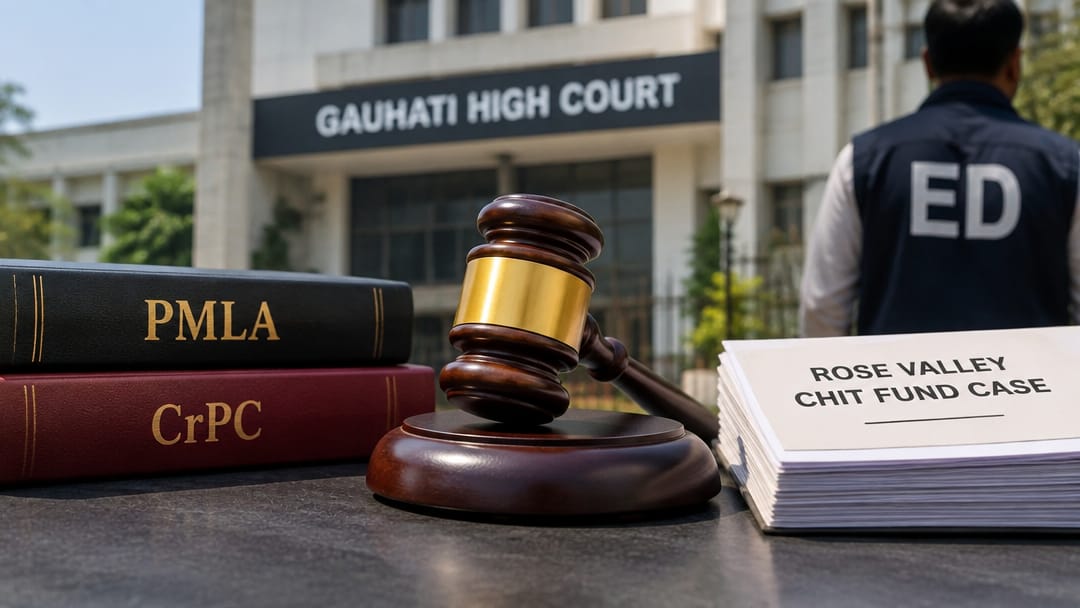
The Gauhati High Court rejected the Enforcement Directorate's plea to interrogate an accused in the Rose Valley chit-fund money-laundering case after the trial had already commenced. The court held that once a Special Court takes cognizance and trial begins under PMLA, the ED cannot initiate fresh investigation or summon the accused for interrogation. The ruling interprets PMLA provisions alongside CrPC to draw a clear line between pre-trial investigation and post-cognizance proceedings.
02 Understand
Why it matters
This ruling turns on a foundational distinction in criminal procedure: the moment a court takes cognizance of an offence, the accused's legal position changes from a suspect under investigation to a person facing trial. At that stage, the rights of the accused under the CrPC (and now BNSS) crystallise, and the investigating agency cannot bypass the court to conduct fresh interrogation.
Under the Prevention of Money Laundering Act (PMLA), the ED has sweeping powers to summon, arrest, and investigate — but these powers are pre-trial in nature. Section 50 PMLA allows the ED to summon persons during investigation. Once the Special Court takes cognizance under Section 44 PMLA, however, the trial machinery takes over. Any further examination of the accused must follow the CrPC framework — cross-examination as a witness, or examination under Section 313 CrPC — not fresh agency interrogation.
The Gauhati HC's ruling also protects Article 20(3) rights (protection against self-incrimination) and Article 21 (personal liberty). Allowing the ED to interrogate an accused mid-trial could effectively force self-incrimination outside the court's supervision.
For CLAT PG, the principle here is the classic pre-cognizance versus post-cognizance divide. Examiners frequently test whether a student understands that investigative powers of police/agencies are curtailed once the court takes cognizance — a principle traceable to Abhinandan Jha v. Dinesh Mishra and the general scheme of CrPC Chapters XII and XVI.
Remember + Why it matters
The key recall facts and exact examiner angle for CLAT PG are in the Crux app.
01
Key figure and date from this topic
02
Specific number or threshold to remember
03
Policy or regulatory implication
Read + Understand free forever · 30-day free trial