01 Read
What happened
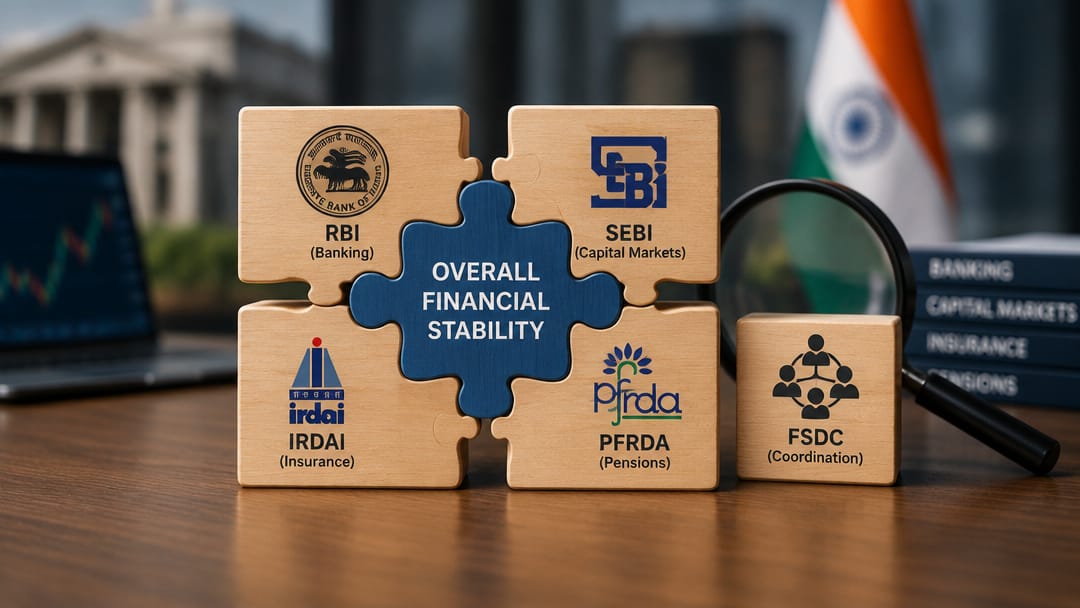
India's financial architecture features multiple sector regulators — RBI for banking, SEBI for capital markets, IRDAI for insurance, PFRDA for pensions — plus coordination bodies like the Financial Stability and Development Council. Despite this dense regulatory presence, a systemic gap persists: no single authority monitors cross-sectoral risks or interconnections. The article argues that India needs a macro-prudential, big-picture regulatory framework to identify systemic vulnerabilities before they cascade across the financial system.
02 Understand
Why it matters
India's financial regulation follows a 'sectoral silo' model — each regulator governs its own domain with limited formal authority over risks that cut across sectors. This contrasts with a macro-prudential approach, which monitors system-wide vulnerabilities such as interconnectedness, leverage cycles, and contagion risks.
The Financial Stability and Development Council (FSDC), established in 2010, was designed to bridge this gap. Chaired by the Finance Minister, it brings together the heads of RBI, SEBI, IRDAI, PFRDA, IBBI, and other bodies. However, FSDC has no independent statutory basis — it was created by an executive order, not an Act of Parliament — and lacks direct regulatory or enforcement powers. It functions as a coordination forum, not a super-regulator.
The static concept being tested here is the architecture of India's financial regulatory framework: who regulates what, what FSDC's mandate and limitations are, and how macro-prudential oversight differs from micro-prudential (entity-level) supervision.
Examiners frequently test whether aspirants can distinguish between the roles of RBI (systemic risk in banking), SEBI (market integrity), and coordination bodies. The absence of a statutory super-regulator is the key structural gap — the UPSC and RBI Grade B examiner will probe this distinction. India's model is sometimes compared to the UK's Financial Policy Committee or the US Financial Stability Oversight Council (FSOC), which have broader macro-prudential mandates.
The Financial Stability and Development Council (FSDC), established in 2010, was designed to bridge this gap. Chaired by the Finance Minister, it brings together the heads of RBI, SEBI, IRDAI, PFRDA, IBBI, and other bodies. However, FSDC has no independent statutory basis — it was created by an executive order, not an Act of Parliament — and lacks direct regulatory or enforcement powers. It functions as a coordination forum, not a super-regulator.
The static concept being tested here is the architecture of India's financial regulatory framework: who regulates what, what FSDC's mandate and limitations are, and how macro-prudential oversight differs from micro-prudential (entity-level) supervision.
Examiners frequently test whether aspirants can distinguish between the roles of RBI (systemic risk in banking), SEBI (market integrity), and coordination bodies. The absence of a statutory super-regulator is the key structural gap — the UPSC and RBI Grade B examiner will probe this distinction. India's model is sometimes compared to the UK's Financial Policy Committee or the US Financial Stability Oversight Council (FSOC), which have broader macro-prudential mandates.
Remember + Why it matters
The key recall facts and exact examiner angle for SEBI Grade A are in the Crux app.
01
Key figure and date from this topic
02
Specific number or threshold to remember
03
Policy or regulatory implication
Read + Understand free forever · 30-day free trial