01 Read
What happened
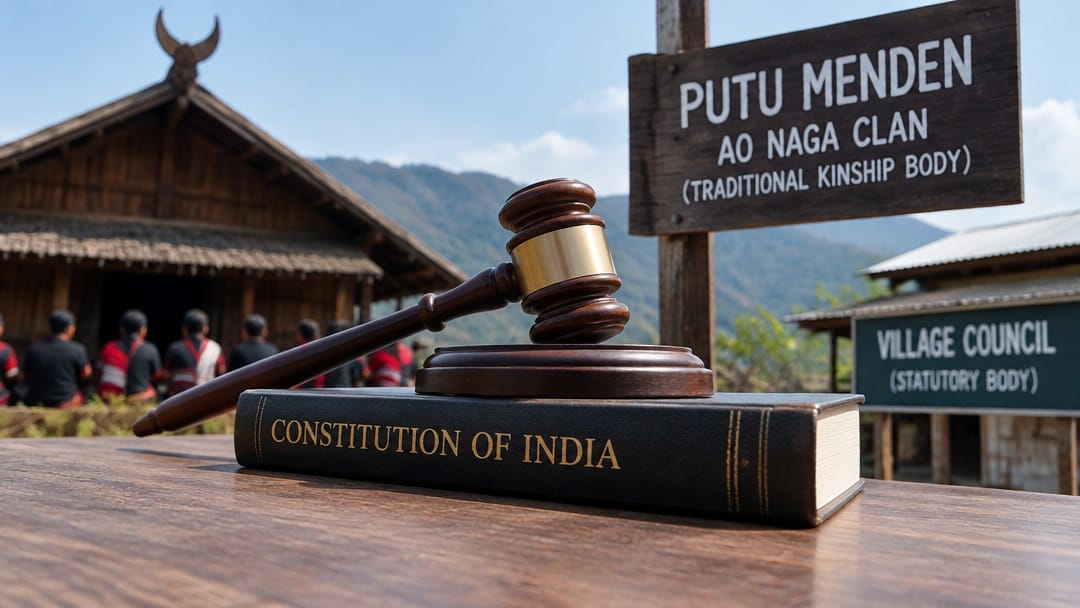
The Gauhati High Court Kohima Bench struck down excommunication orders issued by a village in Mokokchung district, Nagaland, ruling that the Putu Menden — a traditional Ao Naga clan or kinship body — is distinct from a statutory Village Council. The court held that excommunication violating fundamental rights under Articles 19 and 21 cannot be shielded by customary law, and that only bodies with statutory recognition can exercise coercive authority affecting civil rights.
02 Understand
Why it matters
This judgment sits at the intersection of three constitutional doctrines examined heavily in CLAT PG: the scope of fundamental rights against non-state actors, the limits of customary law as a shield against constitutional guarantees, and the distinction between statutory and non-statutory bodies under Article 13.
The core legal principle is that customary or traditional bodies — however socially authoritative — cannot exercise powers that infringe Articles 19 (freedom of movement, residence, profession) and 21 (right to life and personal liberty) unless they are recognised by statute and operate within constitutional limits. The Putu Menden is a traditional Ao Naga clan assembly rooted in custom, whereas the Village Council in Nagaland draws its authority from the Nagaland Village and Area Councils Act, 1978. The HC drew a sharp line: statutory recognition is not merely a procedural label — it determines whether a body's actions can be treated as 'law' or 'state action' and therefore whether they are subject to constitutional scrutiny.
Excommunication — total social ostracism — was held to violate the right to dignity embedded in Article 21 (Maneka Gandhi v. Union of India, 1978; Francis Coralie Mullin v. Union Territory of Delhi, 1981) and the right to reside in Article 19(1)(e). The court followed the principle that even where Article 13 does not directly reach private bodies, practices that are enforced through community coercion and deprive individuals of basic civil rights cannot stand.
For CLAT PG, the examiner will likely extract: (1) the test for distinguishing customary from statutory authority, (2) the applicability of fundamental rights to excommunication orders, and (3) whether Sixth Schedule protection covers such tribal bodies in Nagaland — it does not, because Nagaland operates under Article 371(A), not the Sixth Schedule.
Remember + Why it matters
The key recall facts and exact examiner angle for UPSC CSE are in the Crux app.
01
Key figure and date from this topic
02
Specific number or threshold to remember
03
Policy or regulatory implication
Read + Understand free forever · 30-day free trial