01 Read
What happened
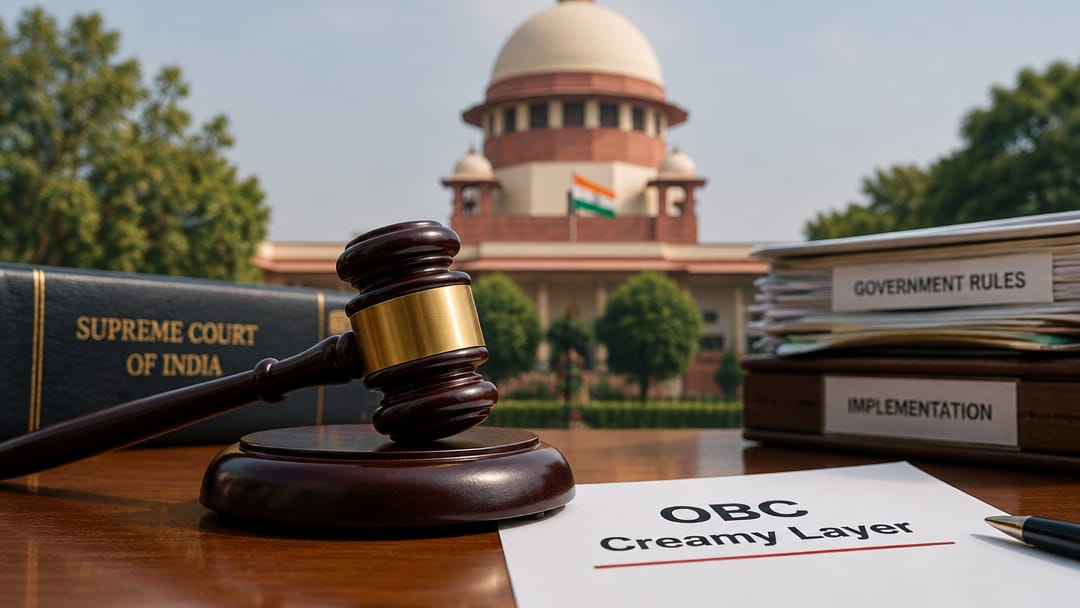
The Supreme Court is examining whether the government can cite unclear departmental rules — rules of its own making — to avoid implementing a court judgment on OBC creamy layer exclusions. The dispute centres on whether bureaucratic self-created ambiguity can legally shield the executive from contempt or compliance obligations. The Court's scrutiny raises a foundational constitutional question: when the state is both the rule-maker and the rule-breaker, does uncertainty it generated excuse non-compliance with a binding judicial order?
02 Understand
Why it matters
This dispute sits at the intersection of three constitutional doctrines that CLAT PG examiners test repeatedly.
First, the doctrine of separation of powers and judicial supremacy in interpreting the Constitution. Under Article 141, the law declared by the Supreme Court is binding on all courts and authorities. Under Article 144, all civil and judicial authorities must act in aid of the Supreme Court. The executive cannot plead its own administrative confusion to escape Article 144 obligations.
Second, the OBC creamy layer doctrine itself. In Indra Sawhney v Union of India (1992), the Supreme Court held that the more affluent and advanced sections among OBCs — the 'creamy layer' — must be excluded from reservation benefits. The government is constitutionally obligated to identify and exclude this layer. Any dilution through administrative inaction is not a neutral act; it is itself a constitutional violation.
Third, the estoppel-by-conduct principle applied to the State. When the government itself drafts ambiguous rules and then pleads that ambiguity to avoid compliance, courts have consistently held that the State cannot approbate and reprobate simultaneously. The rule-maker cannot weaponise its own drafting failure.
For CLAT PG, the core test is: does executive uncertainty — even genuine uncertainty — constitute a legally cognisable defence against contempt of court? The answer from constitutional jurisprudence is no. Wilful disobedience does not require malice; passive non-compliance dressed as administrative confusion suffices for contempt.
Remember + Why it matters
The key recall facts and exact examiner angle for CLAT PG are in the Crux app.
01
Key figure and date from this topic
02
Specific number or threshold to remember
03
Policy or regulatory implication
Read + Understand free forever · 30-day free trial