01 Read
What happened
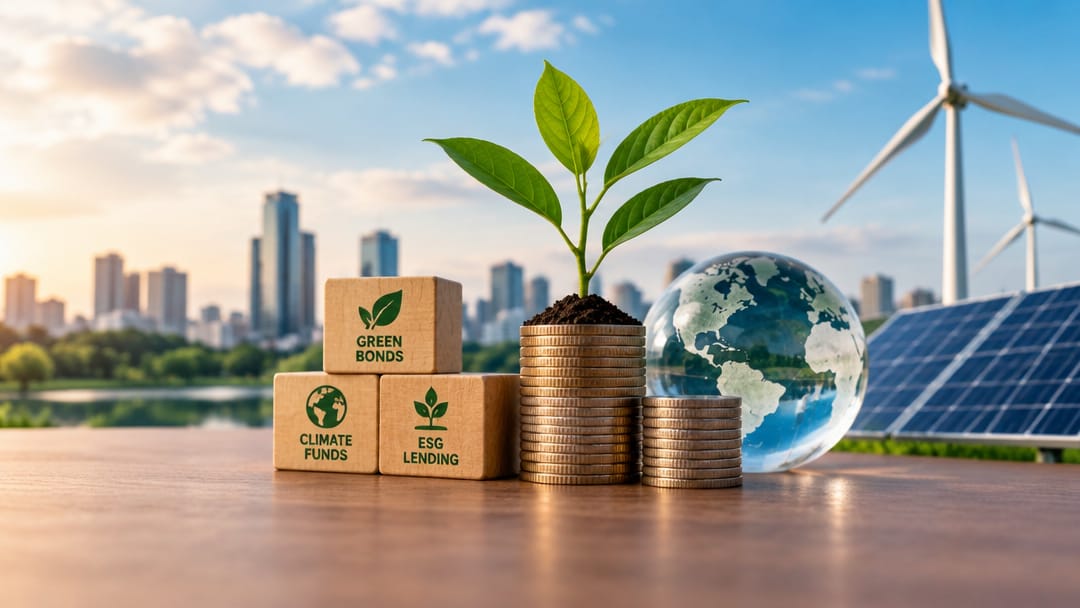
Researchers argue that closing the global sustainable-development financing gap requires green finance and technological innovation to operate as complementary pillars, not independent streams. Green bonds, climate funds, and ESG-linked lending must be paired with clean-tech deployment to deliver measurable emissions reductions. The study highlights that without technological absorptive capacity, financial flows fail to translate into real-economy decarbonisation outcomes, making the finance-technology nexus central to meeting Paris Agreement and SDG targets.
02 Understand
Why it matters
Green finance refers to financial instruments and frameworks specifically designed to fund environmentally sustainable projects — including green bonds, sustainability-linked loans, climate investment funds, and central bank green asset-purchase programmes. India's ecosystem includes the RBI's green deposit framework, SEBI's green bond disclosure norms, and NABARD's climate-linked refinancing for agriculture.
The core argument of the research is that capital alone is insufficient. Technological innovation — clean energy, precision agriculture, carbon capture, climate-resilient infrastructure — is what converts financial flows into actual emissions reductions. Without absorptive technological capacity, money pools in low-risk, low-impact projects (so-called 'greenwashing').
For India, this nexus matters across three levels. At the sovereign level, India's NDC targets (45% emissions intensity reduction by 2030, 500 GW non-fossil capacity) require simultaneous scaling of green capital and clean technology. At the institutional level, RBI's climate risk framework and SEBI's BRSR (Business Responsibility and Sustainability Reporting) push banks and listed companies to disclose how finance is linked to real-economy decarbonisation. At the development-finance level, NABARD's climate bonds and watershed programmes must demonstrate technology-linked outcomes, not just disbursement figures.
The SDG financing gap is estimated at roughly $4 trillion annually globally. Bridging it requires mobilising private capital through blended finance structures where public green finance de-risks private clean-technology investment — a mechanism the G20 Sustainable Finance Working Group has formally endorsed.
Remember + Why it matters
The key recall facts and exact examiner angle for RBI Grade B are in the Crux app.
01
Key figure and date from this topic
02
Specific number or threshold to remember
03
Policy or regulatory implication
Read + Understand free forever · 30-day free trial