01 Read
What happened
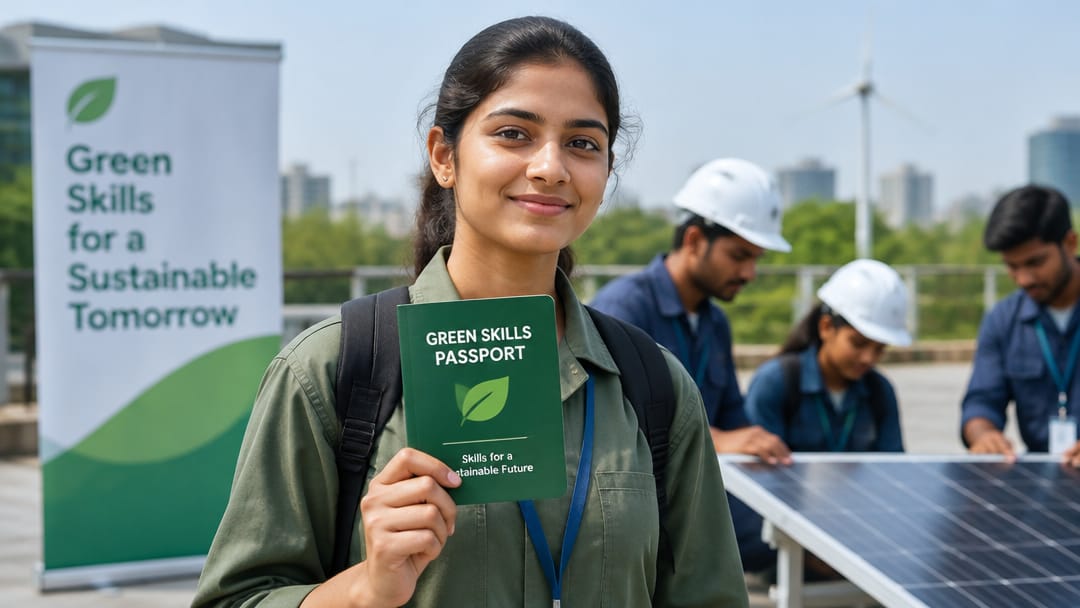
The Green Skills Passport is an EY-led initiative designed to equip youth and underserved communities with sustainability awareness and entrepreneurial competencies needed to access green jobs. It bridges the gap between conventional vocational training and the emerging green economy by offering structured learning pathways. The programme targets populations often excluded from formal skill ecosystems, aiming to make sustainability-linked livelihoods accessible. It aligns with global efforts to build a just transition workforce as economies shift toward low-carbon development models.
02 Understand
Why it matters
The Green Skills Passport sits at the intersection of skilling policy, green economy transition, and social inclusion — three themes that Indian competitive exams increasingly test together.
A 'green job' is defined by the International Labour Organization (ILO) as decent work that contributes to preserving or restoring the environment. India's push toward net-zero by 2070 and its National Green Hydrogen Mission, PM Surya Ghar, and Panchamrit commitments create structural demand for a workforce skilled in renewable energy, sustainable agriculture, waste management, eco-tourism, and climate-resilient infrastructure.
The Green Skills Passport model addresses a known market failure: green sectors are growing, but the labour supply lacks matching credentials. By targeting youth and underserved communities — groups that face barriers to formal education — it also serves a financial inclusion and social equity function relevant to NABARD and RBI syllabi.
For NABARD aspirants, the rural angle is critical: green agriculture, agroforestry, and climate-smart farming are green job categories where rural skilling programmes intersect with priority sector lending and livelihood finance. For RBI aspirants, green finance — green bonds, climate risk in bank lending, ESG disclosures — is the adjacent testable concept. For UPSC aspirants, this connects to India's Nationally Determined Contributions (NDCs), just transition policy, and schemes like PMKVY 4.0, which introduced a green skills component in its latest iteration.
Remember + Why it matters
The key recall facts and exact examiner angle for UPSC CSE are in the Crux app.
01
Key figure and date from this topic
02
Specific number or threshold to remember
03
Policy or regulatory implication
Read + Understand free forever · 30-day free trial