01 Read
What happened
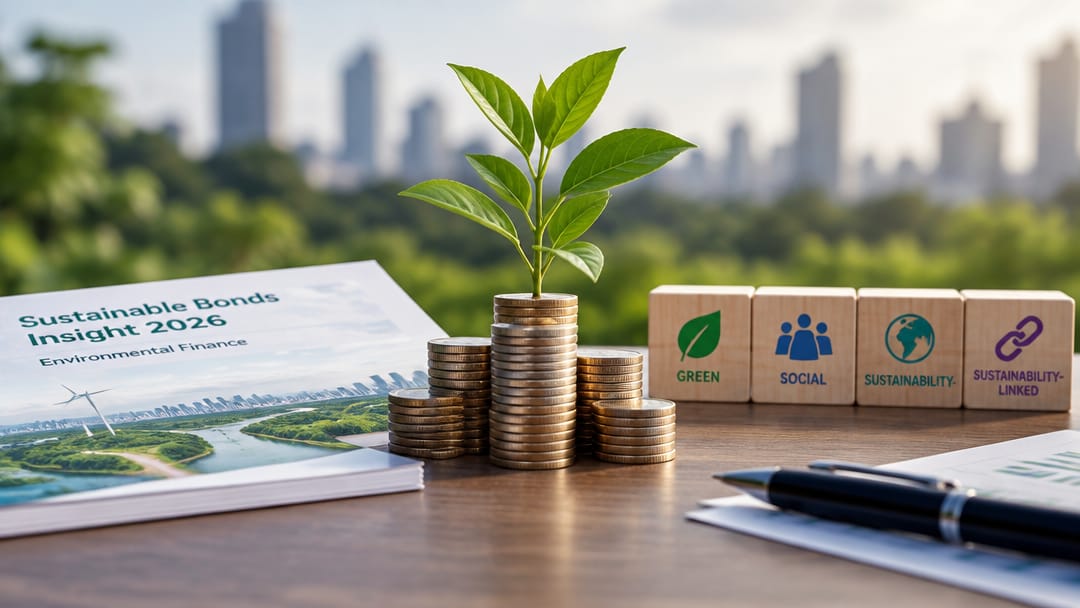
The Sustainable Bonds Insight 2026 report, published by Environmental Finance, tracks global trends in green, social, sustainability, and sustainability-linked bonds — the GSSS market. It covers issuance volumes, use-of-proceeds frameworks, labelling standards, and emerging instruments such as blue and transition bonds. The report is freely downloadable and provides data-rich infographics on how capital markets are channelling private finance toward climate and social objectives, relevant to India's sovereign green bond programme and RBI's green finance guidelines.
02 Understand
Why it matters
The GSSS bond market is the primary mechanism through which capital markets finance the low-carbon transition. Each instrument within it has a distinct architecture worth understanding for exams.
**Green Bonds** raise capital exclusively for projects with measurable environmental benefits — renewable energy, clean transport, green buildings — verified against frameworks like the ICMA Green Bond Principles or the EU Green Bond Standard.
**Social Bonds** finance projects with positive social outcomes: affordable housing, healthcare, education, food security. They follow ICMA Social Bond Principles.
**Sustainability Bonds** combine both green and social use-of-proceeds categories.
**Sustainability-Linked Bonds (SLBs)** are structurally different: proceeds are not ring-fenced for specific projects. Instead, the bond's financial terms (typically the coupon rate) are tied to the issuer meeting pre-defined Sustainability Performance Targets (SPTs). If the issuer misses the target, the coupon steps up — creating a financial penalty. This instruments-vs-outcomes distinction is crucial for exam questions.
In India's context: SEBI issued its Green Bond framework in 2023 (renamed from 2017 circular), defining eligible categories. The RBI issued India's first Sovereign Green Bond (SGB) in January 2023, raising ₹8,000 crore at a 'greenium' (lower yield than comparable government bonds). NABARD issues green bonds for climate-resilient agriculture and acts as a National Implementing Entity under the Adaptation Fund and Green Climate Fund. The GSSS market globally crossed $4 trillion in cumulative issuance by 2024.
**Green Bonds** raise capital exclusively for projects with measurable environmental benefits — renewable energy, clean transport, green buildings — verified against frameworks like the ICMA Green Bond Principles or the EU Green Bond Standard.
**Social Bonds** finance projects with positive social outcomes: affordable housing, healthcare, education, food security. They follow ICMA Social Bond Principles.
**Sustainability Bonds** combine both green and social use-of-proceeds categories.
**Sustainability-Linked Bonds (SLBs)** are structurally different: proceeds are not ring-fenced for specific projects. Instead, the bond's financial terms (typically the coupon rate) are tied to the issuer meeting pre-defined Sustainability Performance Targets (SPTs). If the issuer misses the target, the coupon steps up — creating a financial penalty. This instruments-vs-outcomes distinction is crucial for exam questions.
In India's context: SEBI issued its Green Bond framework in 2023 (renamed from 2017 circular), defining eligible categories. The RBI issued India's first Sovereign Green Bond (SGB) in January 2023, raising ₹8,000 crore at a 'greenium' (lower yield than comparable government bonds). NABARD issues green bonds for climate-resilient agriculture and acts as a National Implementing Entity under the Adaptation Fund and Green Climate Fund. The GSSS market globally crossed $4 trillion in cumulative issuance by 2024.
Remember + Why it matters
The key recall facts and exact examiner angle for UPSC CSE are in the Crux app.
01
Key figure and date from this topic
02
Specific number or threshold to remember
03
Policy or regulatory implication
Read + Understand free forever · 30-day free trial