01 Read
What happened
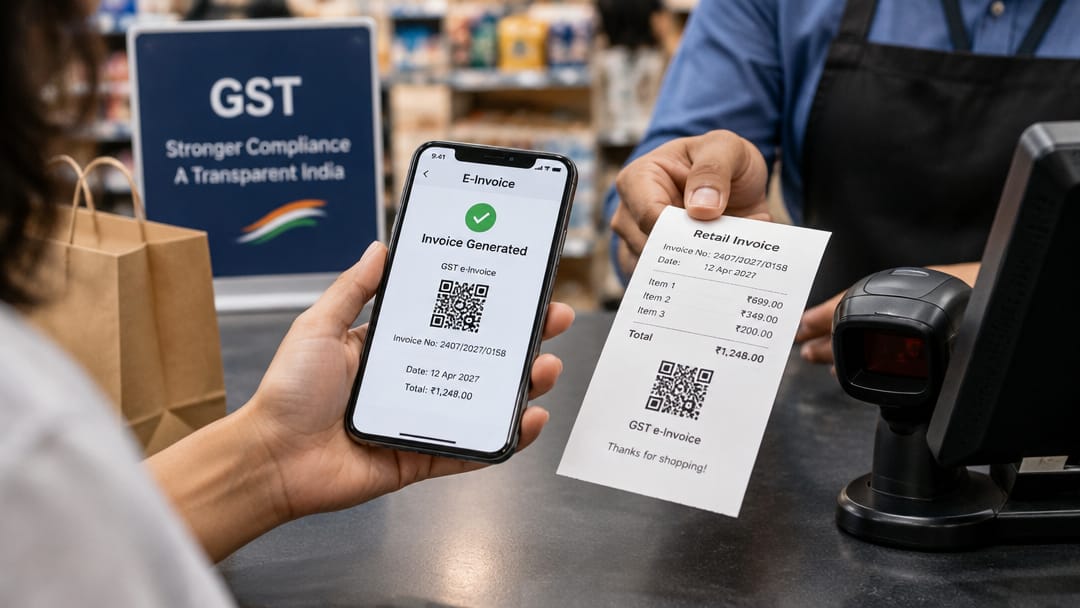
GST authorities are planning a pilot for retail e-invoicing from April 2027, which would electronically record invoices issued by shops and businesses directly to end consumers. Currently, e-invoicing under GST applies only to business-to-business transactions above a certain turnover threshold. Extending it to business-to-consumer retail transactions would significantly widen the GST compliance net, reduce tax evasion at the last mile, and create a verifiable digital audit trail for retail sales across India.
02 Understand
Why it matters
E-invoicing under GST was introduced in October 2020 for large businesses and has been progressively extended to smaller ones. It works by requiring businesses to generate invoices through the Invoice Registration Portal (IRP), which issues a unique Invoice Reference Number (IRN) and QR code. This creates a real-time, tamper-proof record that the GST Network (GSTN) can cross-verify against returns filed by both buyers and sellers.
The critical policy gap has always been the business-to-consumer (B2C) segment. When a retail shop sells to an individual, there is no GST-registered buyer to cross-check the transaction, making suppression of sales easy. Retail e-invoicing would close this gap by electronically capturing B2C transactions at the point of sale itself.
For competitive exams, understand the two-layer significance: (1) Revenue: GST collections have grown from roughly ₹8 lakh crore annually in early years to consistently above ₹20 lakh crore, yet the retail leakage remains large. Retail e-invoicing targets the final, hardest segment. (2) Financial inclusion and formalization: Formalizing retail transactions creates income and expenditure records for small businesses, improving their creditworthiness — a direct NABARD and RBI angle — and enabling better priority sector lending assessments.
The April 2027 pilot date signals a phased, careful rollout rather than an abrupt mandate, consistent with how B2B e-invoicing was itself rolled out in stages from 2020 onward.
Remember + Why it matters
The key recall facts and exact examiner angle for NABARD Grade A are in the Crux app.
01
Key figure and date from this topic
02
Specific number or threshold to remember
03
Policy or regulatory implication
Read + Understand free forever · 30-day free trial