01 Read
What happened
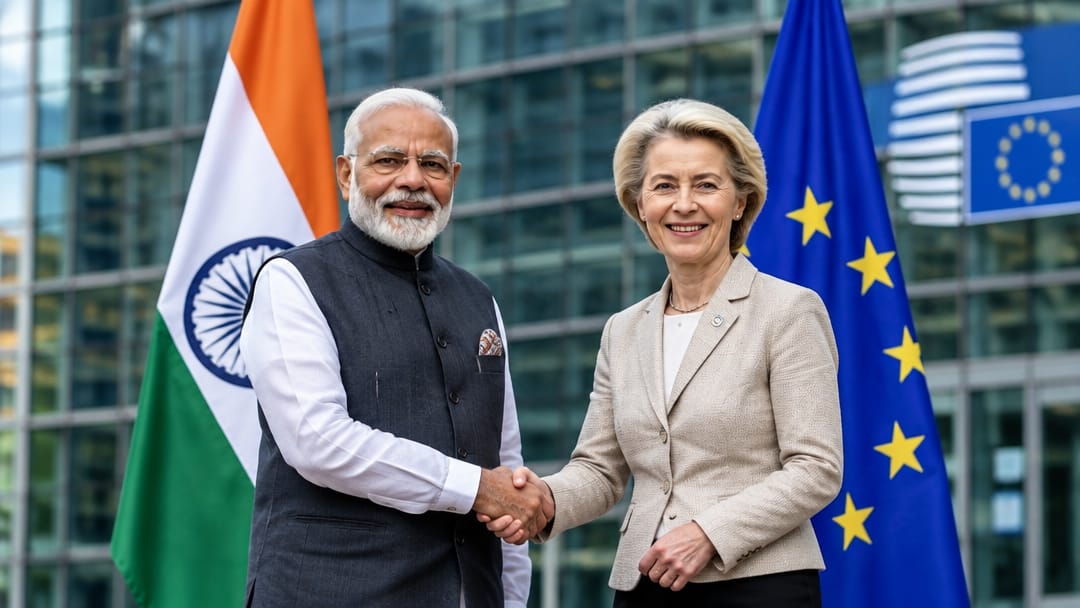
India and the European Union are targeting December 2026 to sign a Free Trade Agreement, potentially during Prime Minister Modi's visit to Brussels. Negotiations, which originally began in 2007 and stalled in 2013, were relaunched in 2022. The deal would cover goods, services, investment, and geographical indications. The EU is India's largest trading partner bloc, with bilateral trade exceeding €120 billion annually, making this one of India's most consequential trade negotiations.
02 Understand
Why it matters
The India–EU FTA, also called the Broad-based Trade and Investment Agreement (BTIA), has been among the most protracted trade negotiations in modern history. Talks began in 2007 under the EU–India Strategic Partnership framework but collapsed in 2013 over disagreements on tariff reductions for automobiles and wines, data security recognition, and market access for generic pharmaceuticals and professional services.
Negotiations were formally relaunched in June 2022 at the India–EU Leaders' Meeting in New Delhi. The revived talks run on three parallel tracks: a Free Trade Agreement (goods and services), an Investment Protection Agreement, and a Geographical Indications Agreement.
For India, the strategic calculus has shifted. The EU represents roughly 15% of India's total exports. Post-Brexit, the UK trade deal has been separately negotiated, removing a major variable. The EU's Carbon Border Adjustment Mechanism (CBAM), which taxes carbon-intensive imports from 2026, gives Indian exporters in steel, aluminium, and chemicals a strong incentive to conclude an FTA that includes climate-compatible provisions.
For the EU, India is a hedge against China-dependency in supply chains, especially after the post-pandemic realignment. The EU has also pushed for labour standards, intellectual property enforcement, and public procurement access — all contentious for India.
A December 2026 signing during a Modi–Brussels summit would be politically symbolic and economically transformative, potentially the largest FTA either party has signed by trade value.
Remember + Why it matters
The key recall facts and exact examiner angle for UPSC CSE are in the Crux app.
01
Key figure and date from this topic
02
Specific number or threshold to remember
03
Policy or regulatory implication
Read + Understand free forever · 30-day free trial