01 Read
What happened
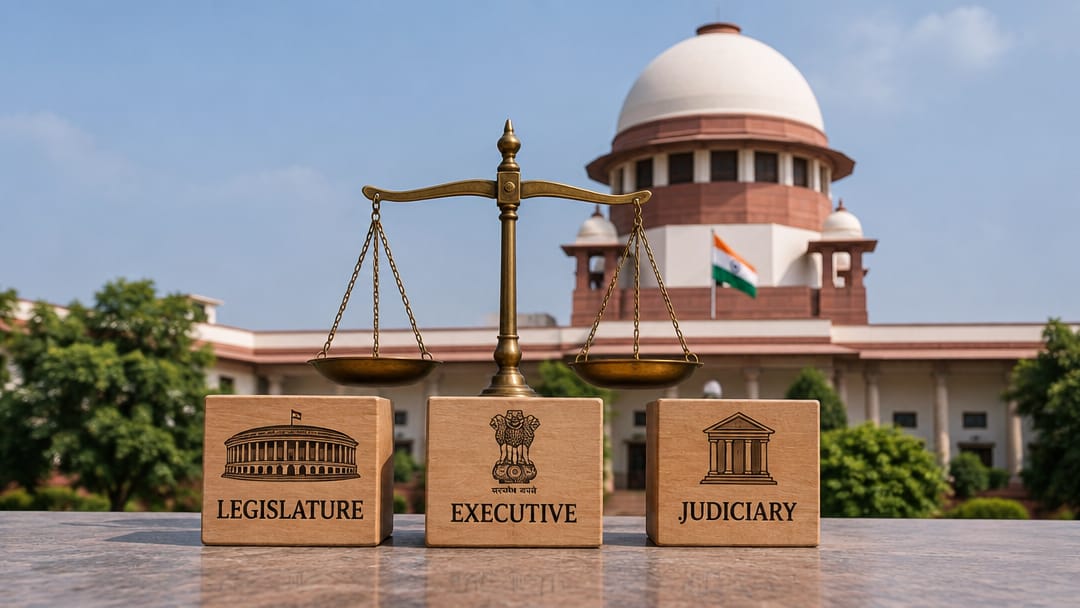
The Supreme Court has consistently held that India's Constitution does not adopt the doctrine of separation of powers in its strict or absolute form. The three organs — Legislature, Executive, and Judiciary — are not watertight compartments. However, the Constitution does distribute functions and builds in checks and balances. Each organ exercises some functions of the other, yet the core constitutional functions of each are protected from usurpation by another organ.
02 Understand
Why it matters
The doctrine of separation of powers, classically articulated by Montesquieu in 'The Spirit of the Laws' (1748), proposes that the legislative, executive, and judicial powers of a state must be vested in distinct and independent organs to prevent tyranny. The United States Constitution comes closest to a strict separation model.
India adopted a modified version. The Constitution does not expressly use the term 'separation of powers,' yet Articles 50, 121, 122, 211, and 212 reflect the principle in specific contexts — for instance, Article 50 directs separation of the judiciary from the executive in public services.
The Supreme Court in Ram Jawaya Kapur v. State of Punjab (1955) first clarified that India does not follow the strict doctrine, but its Constitution does differentiate and assign functions. In Indira Nehru Gandhi v. Raj Narain (1975), the Supreme Court held that separation of powers is part of the basic structure of the Constitution — meaning Parliament cannot destroy it through amendment. The Kesavananda Bharati (1973) judgment underpins this by establishing that core constitutional features, including checks and balances, are unamendable.
Practically, the overlap is real: the President (executive) summons Parliament (legislative); ordinances are executive legislation; judges are appointed through a collegium system that keeps executive interference limited. The key test is whether the essential function of one organ is being usurped, not merely whether some functions overlap. Judicial review — the court's power to strike down laws — is itself a check by the judiciary on the legislature and executive, and is a cornerstone of this modified doctrine.
Remember + Why it matters
The key recall facts and exact examiner angle for UPSC CSE are in the Crux app.
01
Key figure and date from this topic
02
Specific number or threshold to remember
03
Policy or regulatory implication
Read + Understand free forever · 30-day free trial