01 Read
What happened
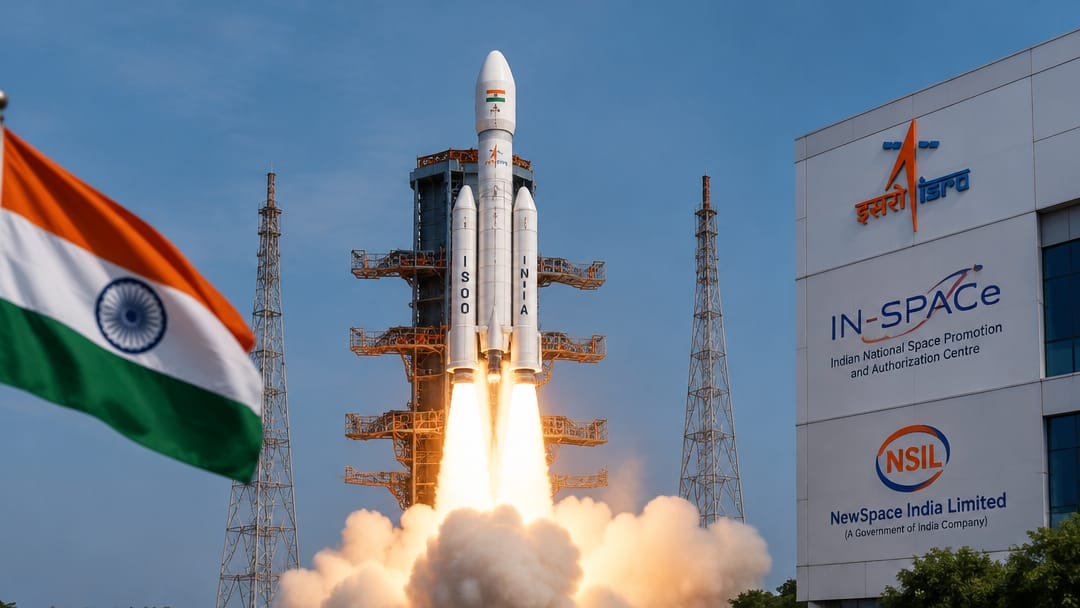
India's space sector is being restructured around three pillars: ISRO as the research and development engine, IN-SPACe as the independent regulator and promoter for private players, and NewSpace India Limited as the commercial arm. Together they operationalise India's Space Policy 2023, which formally opened the sector to private enterprise. The policy assigns ISRO the task of advancing frontier technology while commercial and operational roles shift progressively to industry and NSIL.
02 Understand
Why it matters
India's Space Policy 2023 marks a structural shift from a state-monopoly model to a government-industry partnership. For four decades, ISRO simultaneously designed, built, launched, and commercialised India's space assets. The 2023 policy unbundles these functions.
ISRO retains its core mandate: cutting-edge research, human spaceflight (Gaganyaan), planetary exploration, and next-generation launch vehicle development. It acts as the technology generator and knowledge custodian.
IN-SPACe (Indian National Space Promotion and Authorisation Centre), established under the Department of Space in 2020, is the single-window regulator and promoter for non-governmental entities (NGEs). It authorises launches, grants spectrum, and ensures India's international obligations under the Outer Space Treaty are met. Crucially, IN-SPACe is both regulator and promoter — a dual mandate designed to accelerate private sector growth while maintaining oversight.
NewSpace India Limited (NSIL), incorporated in 2019 as a Central Public Sector Enterprise under the Department of Space, is the demand-driven commercial entity. It executes launch contracts, leases satellite capacity, and transfers ISRO-developed technologies to industry. NSIL's model is explicitly demand-driven rather than supply-push.
The policy also establishes India's intent to increase its share of the global space economy from roughly 2% to 10% by 2030 — a figure the examiner has repeatedly blanked out. The Gaganyaan programme (first uncrewed flight completed with Vyommitra robot), and upcoming missions like NISAR (joint NASA-ISRO SAR satellite) represent ISRO's frontier role under the new framework.
Remember + Why it matters
The key recall facts and exact examiner angle for UPSC CSE are in the Crux app.
01
Key figure and date from this topic
02
Specific number or threshold to remember
03
Policy or regulatory implication
Read + Understand free forever · 30-day free trial