01 Read
What happened
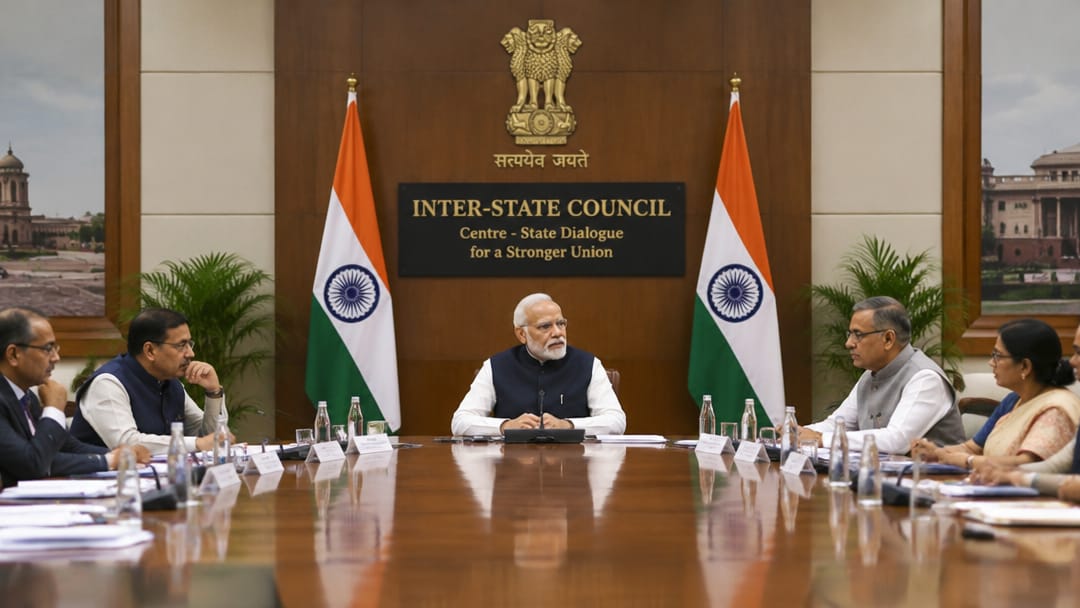
An opinion piece argues that India's cooperative federalism remains aspirational because the Inter-State Council, a constitutional body under Article 263 meant for Centre-state deliberation, has been largely dormant. The Council last met in 2016 and before that in 2006. The author calls for reviving it as a structured, regular forum for shared decision-making between the Union and states, noting the Constitution already provides this mechanism without requiring new legislation.
02 Understand
Why it matters
Article 263 of the Constitution empowers the President to establish an Inter-State Council if it appears to him that the public interests would be served by its creation. The Council is designed to inquire into and advise on disputes between states, investigate subjects of common interest, and make recommendations for better coordination of policy and action. It is not a permanent constitutional body like the Election Commission; it exists only when constituted by a presidential order.
The Inter-State Council was actually constituted in 1990 on the recommendation of the Sarkaria Commission. Its meetings have been infrequent: it met eleven times between 1990 and 2016, then went dormant. The Standing Committee of the Council, chaired by the Home Minister, handles inter-session matters.
The constitutional doctrine of cooperative federalism — the idea that the Union and states must work collaboratively rather than in a purely hierarchical manner — has been repeatedly invoked by the Supreme Court, notably in S.R. Bommai v. Union of India (1994) and more recently in State of West Bengal v. Union of India and the GST judgments. The court has held federalism to be a basic structure element, though Indian federalism remains asymmetric: the Constitution provides for residuary powers with the Union (Article 248), allows Central intervention through Articles 356 and 360, and gives Parliament overriding legislative authority in emergencies.
For CLAT PG, the key distinction is between Article 263 (Inter-State Council, advisory and coordinative) and Article 131 (original jurisdiction of the Supreme Court in inter-state disputes). The two are often confused. Article 263 is a political-executive mechanism; Article 131 is a judicial mechanism.
Remember + Why it matters
The key recall facts and exact examiner angle for UPSC CSE are in the Crux app.
01
Key figure and date from this topic
02
Specific number or threshold to remember
03
Policy or regulatory implication
Read + Understand free forever · 30-day free trial