01 Read
What happened
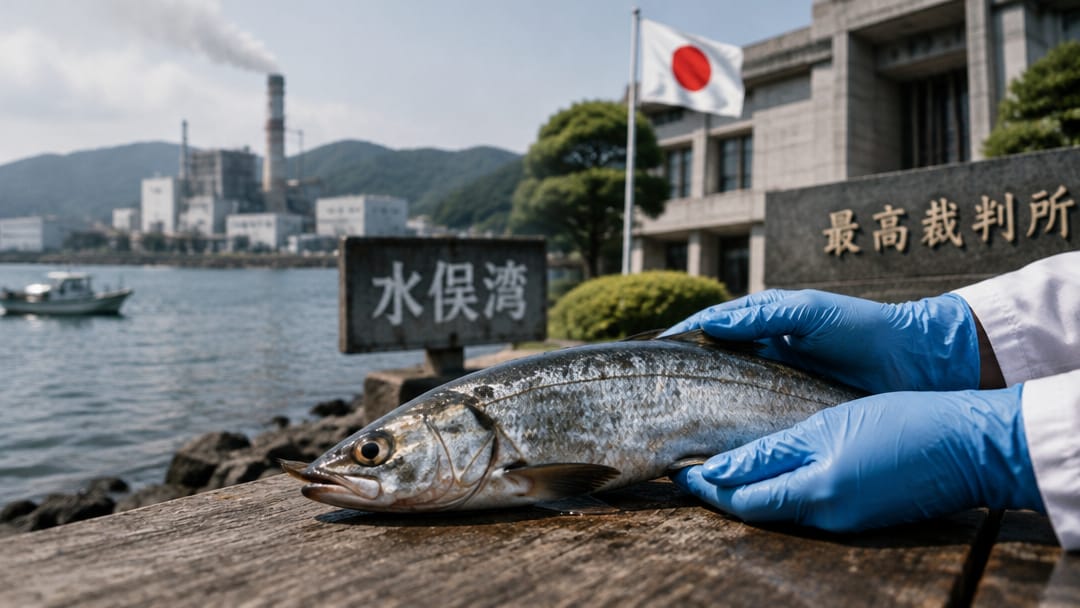
Japan's Supreme Court in 2004 held the national government liable for failing to regulate Chisso Corporation's mercury discharge into Minamata Bay, which caused severe neurological damage from the 1950s onward. The ruling confirmed that the state's inaction constituted a breach of its duty to protect public health. Methylmercury bioaccumulated through the food chain into fish, which local communities consumed heavily. The case established landmark principles of state environmental liability and the precautionary approach in pollution-related tort law.
02 Understand
Why it matters
Minamata Disease is the name given to severe methylmercury poisoning first observed in Minamata, Japan, in 1956. Chisso Corporation's chemical plant discharged mercury-laden wastewater into Minamata Bay for decades. Methylmercury entered the aquatic food chain and bioaccumulated in fish and shellfish. Fishing communities who depended on these fish suffered damage to the central nervous system — loss of vision, hearing, motor coordination, and, in prenatal cases, congenital neurological defects.
The 2004 Japanese Supreme Court judgment was a watershed moment for environmental law globally. It held the Japanese national government liable alongside the corporate polluter, establishing that regulatory inaction — the failure to use available legal powers to stop known pollution — is itself actionable negligence. This shifts the frame from 'polluter pays' to 'regulator must act.'
For Indian environmental law, the parallels are direct. India's Environment Protection Act (1986), the Water (Prevention and Control of Pollution) Act (1974), and the National Green Tribunal Act (2010) all vest regulatory agencies (CPCB, SPCBs) with powers to act against polluters. The Minamata precedent supports arguments that failure to exercise these powers can attract state liability.
The Minamata Convention on Mercury (2013), a global treaty under UNEP, takes its name from this disaster. India signed and ratified it. The Convention requires parties to phase out mercury use in specific products and processes, control artisanal gold mining emissions, and manage mercury waste — directly relevant to India's industrial and mining sectors.
For NABARD aspirants, mercury contamination of water bodies affects rural aquatic ecosystems and fishing livelihoods — a rural ecology dimension the examiner may test through application scenarios.
Remember + Why it matters
The key recall facts and exact examiner angle for NABARD Grade A are in the Crux app.
01
Key figure and date from this topic
02
Specific number or threshold to remember
03
Policy or regulatory implication
Read + Understand free forever · 30-day free trial