01 Read
What happened
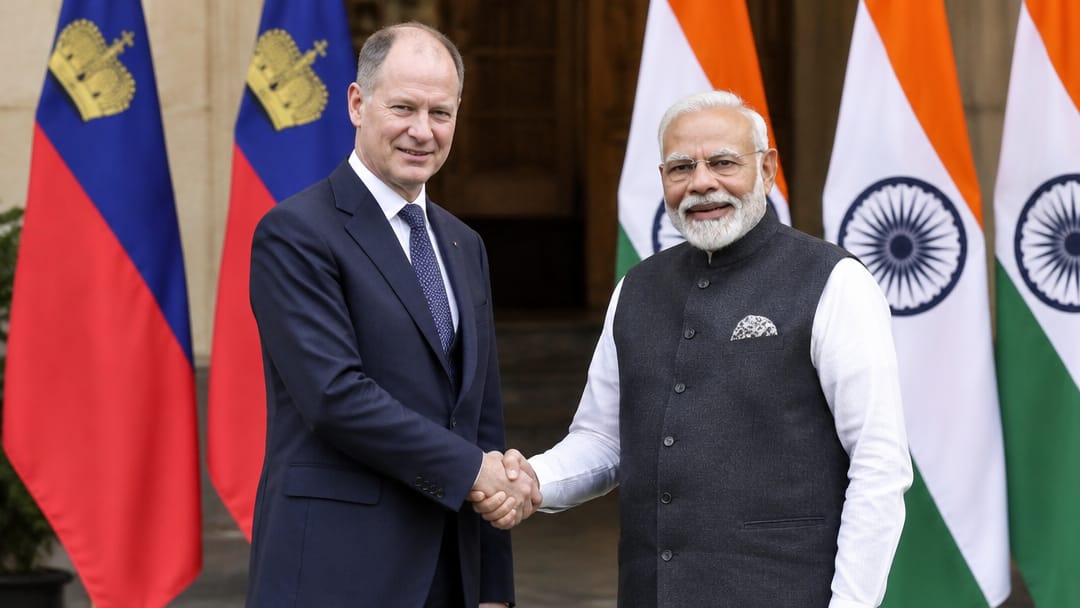
Hereditary Prince Alois of Liechtenstein visited India shortly after the first anniversary of the India-EFTA Trade and Economic Partnership Agreement (TEPA). The visit focused on expanding bilateral trade, technology cooperation, and investment. Liechtenstein is one of four EFTA members alongside Switzerland, Norway, and Iceland. The TEPA, operationalised in 2024, includes a landmark $100 billion investment commitment to India over 15 years, with Liechtenstein's precision engineering and financial services sectors among the key areas of engagement.
02 Understand
Why it matters
The India-EFTA TEPA is a landmark trade agreement between India and the four-member European Free Trade Association — Switzerland, Norway, Iceland, and Liechtenstein. Unlike a conventional Free Trade Agreement (FTA), TEPA includes a binding investment pledge: EFTA nations collectively committed to facilitate $100 billion in investments into India over 15 years, covering sectors like manufacturing, technology, and financial services. This is historically significant because India had not concluded a major trade deal with any developed-country bloc for over a decade before TEPA.
Liechtenstein, though tiny (population ~39,000), is economically potent — it is one of the wealthiest nations per capita and hosts major precision manufacturing and financial holding companies. Its membership in EFTA (not the EU) makes it a distinct bilateral partner for India.
The Hereditary Prince's visit signals Liechtenstein's intent to deepen the bilateral relationship beyond what TEPA mandates at the bloc level. For India, engagement with individual EFTA members matters because investment commitments under TEPA are disaggregated by country.
For exam purposes, the TEPA is testable across multiple angles: its signing date (March 2024), the $100 billion investment figure, the distinction between EFTA and EU membership, and the fact that TEPA is not a conventional goods-only FTA but includes services and intellectual property chapters. UPSC has consistently tested India's bilateral and multilateral trade frameworks, while RBI Grade B tests institutional membership and investment mechanisms.
Remember + Why it matters
The key recall facts and exact examiner angle for UPSC CSE are in the Crux app.
01
Key figure and date from this topic
02
Specific number or threshold to remember
03
Policy or regulatory implication
Read + Understand free forever · 30-day free trial