01 Read
What happened
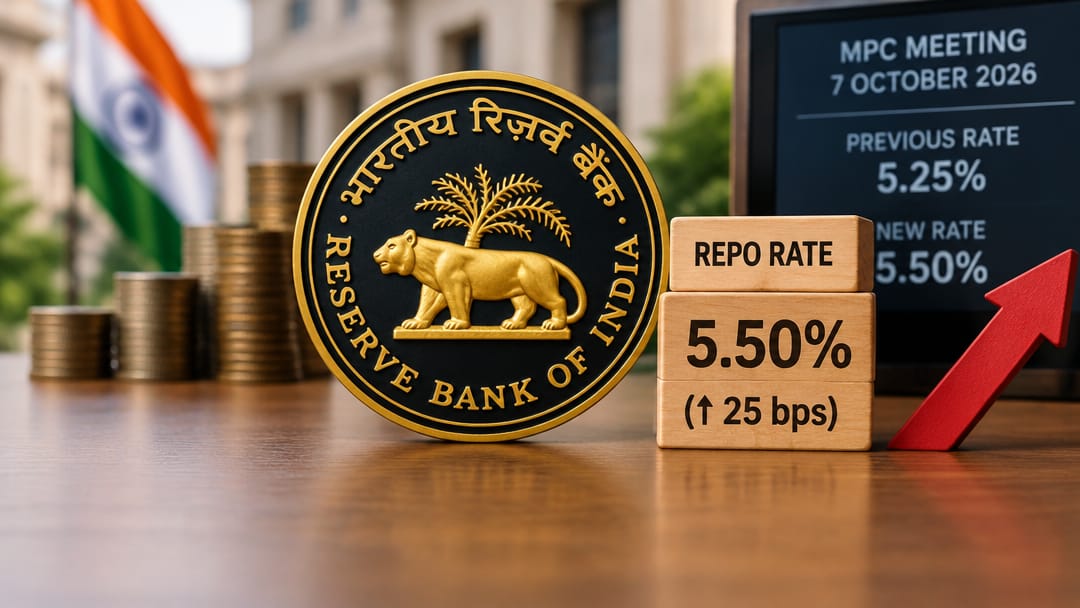
On 7 October 2026, the RBI's Monetary Policy Committee raised the repo rate by 25 basis points to 5.50%, reversing the December 2025 cut to 5.25%. The hike signals a shift from growth support back to inflation control. The Standing Deposit Facility and Marginal Standing Facility rates were adjusted accordingly. Floating-rate borrowers face higher EMIs or longer tenures, while fixed deposit holders benefit from improved returns as banks reprice both lending and deposit rates upward.
02 Understand
Why it matters
The repo rate is the rate at which the RBI lends overnight funds to commercial banks under the Liquidity Adjustment Facility. It anchors the entire interest-rate structure in the economy. When the MPC raises it, the LAF corridor shifts: the Standing Deposit Facility rate (floor) and the Marginal Standing Facility rate (ceiling) move in lockstep, typically maintaining a symmetric 25-basis-point spread on each side of the repo rate.
Transmission to credit markets happens through two channels. External Benchmark Lending Rate-linked loans reprice almost immediately — banks are mandated to reset EBLR at least once every three months — meaning home and auto loan EMIs rise quickly. MCLR-linked loans reprice more slowly, as MCLR depends on the bank's own cost of funds.
On the macroeconomic side, rate hikes work by raising the cost of credit, which dampens consumption and investment demand, reducing inflationary pressure. This is the standard demand-side channel of monetary transmission. The RBI operates under a flexible inflation targeting framework, with a legislated target of 4% CPI inflation (tolerance band: 2%–6%). When inflation persistently trends toward or above the upper band, the MPC is mandated to act.
For UPSC aspirants, the key concept is the transmission mechanism and the inflation-targeting mandate under the RBI Act, 1934 (amended 2016). For RBI Grade B aspirants, the exact rate levels, LAF corridor structure, and vote-count conventions are exam-critical. For NABARD aspirants, repo rate changes affect NABARD's refinancing costs and therefore the interest rates on agricultural credit extended through RRBs and cooperative banks.
Transmission to credit markets happens through two channels. External Benchmark Lending Rate-linked loans reprice almost immediately — banks are mandated to reset EBLR at least once every three months — meaning home and auto loan EMIs rise quickly. MCLR-linked loans reprice more slowly, as MCLR depends on the bank's own cost of funds.
On the macroeconomic side, rate hikes work by raising the cost of credit, which dampens consumption and investment demand, reducing inflationary pressure. This is the standard demand-side channel of monetary transmission. The RBI operates under a flexible inflation targeting framework, with a legislated target of 4% CPI inflation (tolerance band: 2%–6%). When inflation persistently trends toward or above the upper band, the MPC is mandated to act.
For UPSC aspirants, the key concept is the transmission mechanism and the inflation-targeting mandate under the RBI Act, 1934 (amended 2016). For RBI Grade B aspirants, the exact rate levels, LAF corridor structure, and vote-count conventions are exam-critical. For NABARD aspirants, repo rate changes affect NABARD's refinancing costs and therefore the interest rates on agricultural credit extended through RRBs and cooperative banks.
Remember + Why it matters
The key recall facts and exact examiner angle for RBI Grade B are in the Crux app.
01
Key figure and date from this topic
02
Specific number or threshold to remember
03
Policy or regulatory implication
Read + Understand free forever · 30-day free trial