01 Read
What happened
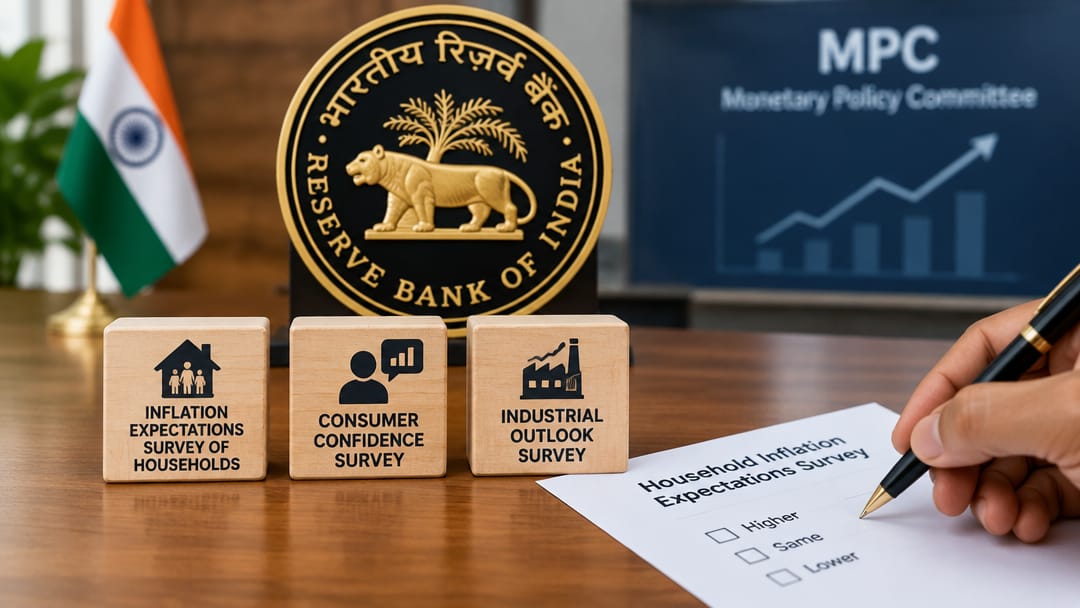
The Reserve Bank of India has launched three surveys — the Inflation Expectations Survey of Households, the Consumer Confidence Survey, and the Industrial Outlook Survey — to gather forward-looking data ahead of its bi-monthly Monetary Policy Committee meeting. These surveys capture household perceptions of current and future inflation, consumer sentiment on economic conditions, and business expectations on output and employment, feeding directly into the MPC's inflation-targeting framework under the flexible inflation targeting mandate.
02 Understand
Why it matters
India's monetary policy operates under a flexible inflation targeting framework, legally established through an amendment to the RBI Act in 2016. The MPC is mandated to maintain CPI inflation at 4%, with a tolerance band of ±2% (i.e., 2%–6%). Rate decisions cannot rely solely on current CPI prints — the MPC must anticipate where inflation is heading. This is where surveys become analytically indispensable.
The Inflation Expectations Survey of Households (IESH) is conducted across 19 cities, covering 6,000 households. It captures whether people expect prices to rise, stabilise, or fall over the next three months and one year. If household expectations become unanchored — meaning people consistently expect high inflation — it becomes self-fulfilling: workers demand higher wages, firms raise prices pre-emptively, and the inflation spiral widens. Central banks therefore watch expectation data as closely as actual CPI.
The Consumer Confidence Survey (CCS) measures sentiment on current economic conditions and one-year-ahead outlook on income, spending, employment, and the general economy. A deteriorating confidence index signals demand compression ahead, which in turn affects the inflation-growth trade-off the MPC must navigate.
The Industrial Outlook Survey captures business expectations on production, order books, employment, and costs — a leading indicator for core inflation pressures.
Together, these three surveys operationalise the 'forward-looking' character of inflation targeting. The examiner tests not just whether you know these surveys exist, but what they measure, why central banks use expectation data, and how they interact with the Taylor Rule logic underlying repo rate decisions.
Remember + Why it matters
The key recall facts and exact examiner angle for UPSC CSE are in the Crux app.
01
Key figure and date from this topic
02
Specific number or threshold to remember
03
Policy or regulatory implication
Read + Understand free forever · 30-day free trial