01 Read
What happened
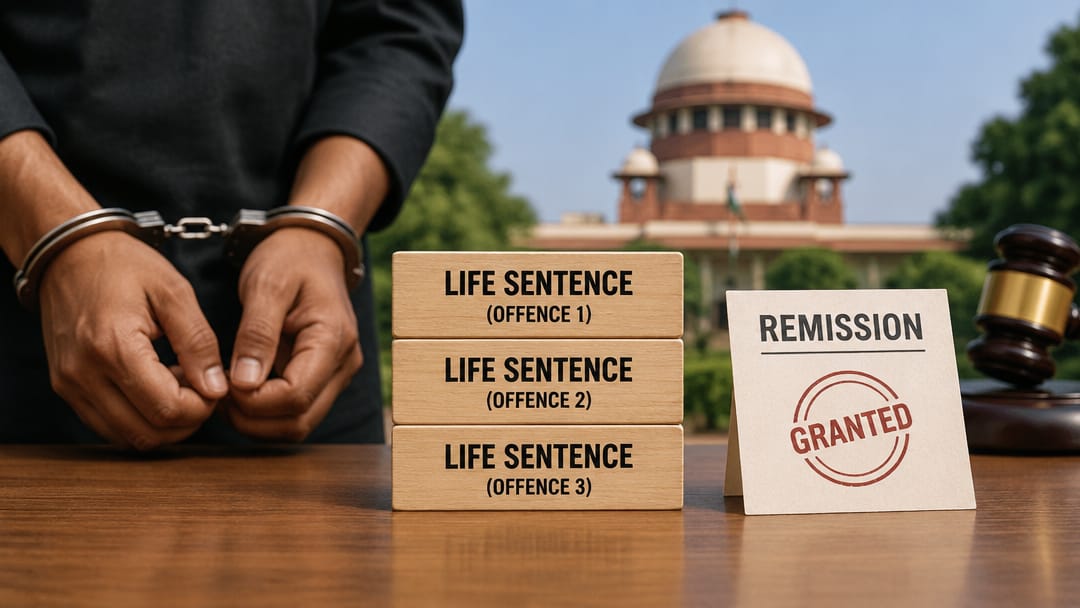
The Supreme Court has reiterated that when a convict receives life sentences for multiple offences, those sentences cannot run consecutively one after another. Instead, they run concurrently but are superimposed over each other, meaning the convict serves them simultaneously. Crucially, the Court clarified that if the government grants remission of one life sentence, that remission does not automatically affect or extinguish the remaining life sentences imposed for other offences. Each life term operates independently for remission purposes.
02 Understand
Why it matters
This ruling clarifies a structurally important principle in Indian sentencing law rooted in Section 31 of the Code of Criminal Procedure, 1973 (now mirrored in Section 6 of the BNSS, 2023). Section 31 CrPC gives the court discretion to direct whether sentences for multiple offences run concurrently or consecutively. However, life imprisonment occupies a special position in this framework — it cannot follow another life sentence consecutively because life imprisonment, by definition, lasts for the remainder of the convict's natural life. You cannot serve 'two lives' sequentially.
The doctrine of 'superimposition' resolves this: multiple life sentences run simultaneously but are layered upon each other. The practical consequence emerges at the remission stage. Remission under Section 432 CrPC (Section 473 BNSS) is granted by the appropriate government for a specific sentence. If Sentence A (life for murder) is remitted, the convict does not walk free if Sentence B (life for dacoity with murder) is still operative. Each life term is independently subject to the remission power of the appropriate government.
This principle also connects to Article 72 (Presidential pardon) and Article 161 (Governor's pardon) of the Constitution, which operate offence-specifically. The examiner tests whether aspirants understand that remission is sentence-specific, not person-specific — the most common distractor being that remission of one sentence automatically releases the convict from all sentences.
Remember + Why it matters
The key recall facts and exact examiner angle for CLAT PG are in the Crux app.
01
Key figure and date from this topic
02
Specific number or threshold to remember
03
Policy or regulatory implication
Read + Understand free forever · 30-day free trial