01 Read
What happened
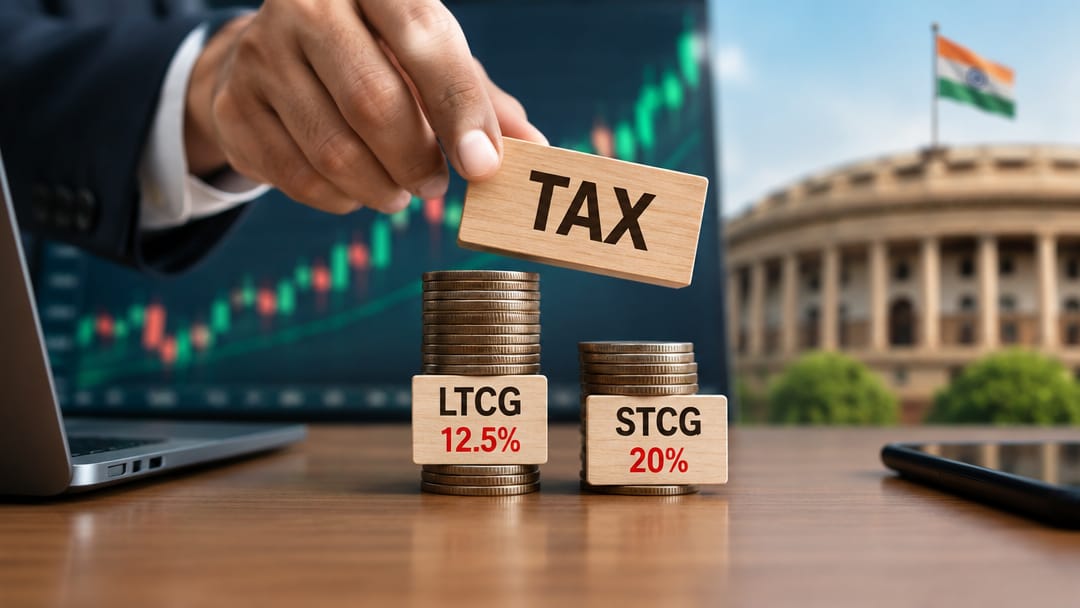
The PHD Chamber of Commerce and Industry (PHDCCI) has formally urged the Indian government to abolish long-term capital gains (LTCG) tax on listed equities and reduce the short-term capital gains (STCG) tax rate. Currently, LTCG above ₹1.25 lakh on listed equities is taxed at 12.5%, while STCG is taxed at 20%. PHDCCI argues these rates discourage retail equity investment and dampen capital market participation, and has submitted its recommendations ahead of the Union Budget.
02 Understand
Why it matters
Capital gains taxes on equities sit at the intersection of fiscal policy, capital market regulation, and investment incentives — making this topic testable across UPSC, SEBI, and RBI exams.
Long-term capital gains (LTCG) tax applies when listed equity shares or equity mutual fund units are held for more than 12 months before sale. Before the Finance Act 2018, LTCG on listed equities was fully exempt. The 2018 Budget reintroduced LTCG at 10% (above ₹1 lakh exemption), and the 2024 Budget revised it to 12.5% (above ₹1.25 lakh exemption). Short-term capital gains (STCG) — for holdings under 12 months — rose from 15% to 20% in 2024.
The PHDCCI's argument rests on a transmission logic: lower or zero LTCG encourages retail investors to hold equities longer, deepening market liquidity. This benefits firms seeking equity capital and reduces dependence on bank credit for long-term funding — a concern directly relevant to RBI's credit transmission analysis.
For SEBI aspirants, the relevance is regulatory: capital gains tax policy affects market microstructure, turnover, and investor participation — all areas SEBI monitors.
For UPSC, this connects to the broader debate on progressive versus growth-oriented taxation, and the fiscal cost of tax exemptions (revenue foregone).
The key exam trap: LTCG and STCG rates have changed in both 2018 and 2024 — aspirants must track current rates, the exemption threshold, and the holding period, as examiners routinely blank these out.
Remember + Why it matters
The key recall facts and exact examiner angle for UPSC CSE are in the Crux app.
01
Key figure and date from this topic
02
Specific number or threshold to remember
03
Policy or regulatory implication
Read + Understand free forever · 30-day free trial