01 Read
What happened
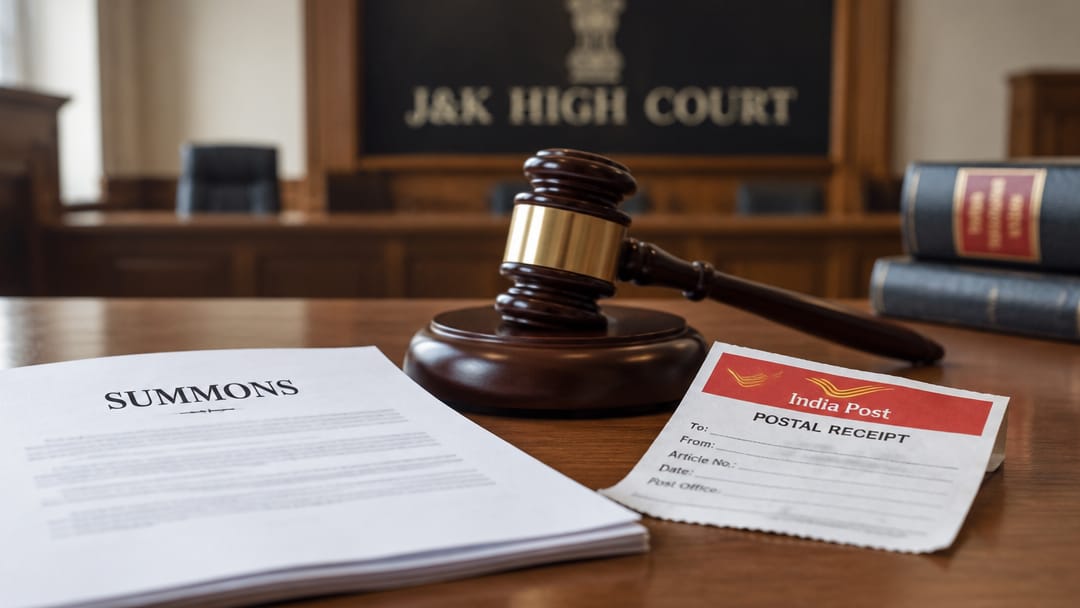
The Jammu & Kashmir High Court set aside a lower court order that had rejected the government's plea to reopen an ex parte decree. The court held that a mere postal receipt is insufficient proof of service of summons — actual delivery must be established. Because the government had not been properly served, proceeding ex parte and passing the decree was a procedural error. The court directed the trial court to allow the government to contest the matter afresh.
02 Understand
Why it matters
This ruling turns on a fundamental question in civil procedure: what constitutes valid service of summons? Under Order V of the Code of Civil Procedure, 1908, service of summons must be duly effected upon the defendant before a court can proceed. When a defendant fails to appear, a court may pass an ex parte decree under Order IX Rule 6 CPC. However, that power is conditional on proper prior service. A postal receipt only shows that a letter was dispatched — it does not confirm that the addressee actually received it. The distinction between dispatch and delivery is legally critical. For service by post to be legally complete, the letter must be shown to have been delivered, typically through an acknowledgement of receipt (postal AD card or process server's endorsement). The court applied the principle that an ex parte decree obtained without proper service is void or voidable, and the aggrieved party may seek to set it aside under Order IX Rule 13 CPC, which allows a defendant to apply to set aside an ex parte decree by showing either that summons were not duly served or that they were prevented by sufficient cause from appearing. This ruling is significant because government departments are frequent defendants in civil suits, and proof of service is often contested. The J&K High Court drew a clear line: process cannot substitute substance in procedural compliance.
Remember + Why it matters
The key recall facts and exact examiner angle for CLAT PG are in the Crux app.
01
Key figure and date from this topic
02
Specific number or threshold to remember
03
Policy or regulatory implication
Read + Understand free forever · 30-day free trial