01 Read
What happened
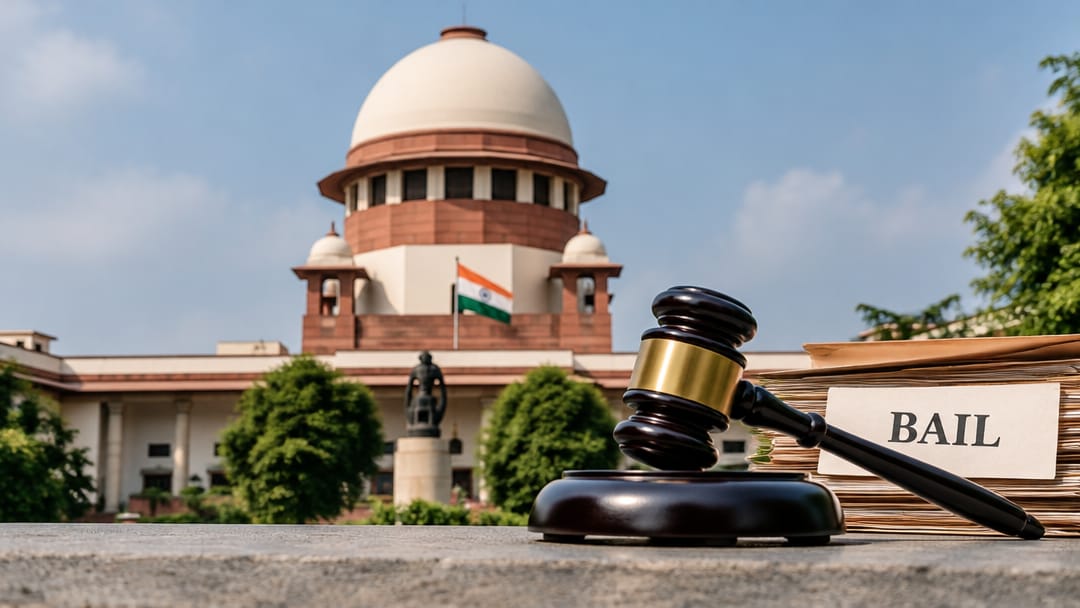
The Supreme Court granted bail to Mahesh Chandra Joshi and Mukesh Pathak, accused in an alleged ₹979.45 crore fraud in Jal Jeevan Mission tenders. The Court held that prolonged pre-trial detention effectively punishes an accused before conviction, violating the presumption of innocence. Reiterating that bail is the rule and jail the exception, the Court emphasised that continued custody without trial completion cannot be used as a substitute for sentencing.
02 Understand
Why it matters
This ruling reinforces one of the most tested principles in CLAT PG criminal procedure: the constitutional and statutory framework governing bail is premised on the presumption of innocence under Article 21. Pre-trial detention is a preventive measure, not a punitive one. When detention becomes indefinitely prolonged due to trial delays, it transforms into de facto punishment — which is constitutionally impermissible.
The Court's reasoning draws on the settled position from cases like Sanjay Chandra v. CBI (2012) and Satender Kumar Antil v. CBI (2022), where the Supreme Court held that economic offences, though serious, do not automatically justify denial of bail. Gravity of the offence is a relevant factor but not the sole determinant.
Under Section 437 and Section 439 of the CrPC (now Sections 480 and 483 of BNSS 2023), courts must weigh the triple test: flight risk, likelihood of tampering with evidence, and repeat offence risk. Conditions imposed must have a direct nexus to these objectives — not be punitive in nature.
The examiner frequently tests whether aspirants understand the distinction between bail conditions that serve legitimate custodial purposes versus those that are irrelevant or oppressive. An irrelevant condition — like demanding a surety from another state — can itself violate Article 21 by making bail practically illusory. This judgment is a textbook illustration of the principle that the bail system must serve liberty, not undermine it.
Remember + Why it matters
The key recall facts and exact examiner angle for CLAT PG are in the Crux app.
01
Key figure and date from this topic
02
Specific number or threshold to remember
03
Policy or regulatory implication
Read + Understand free forever · 30-day free trial