01 Read
What happened
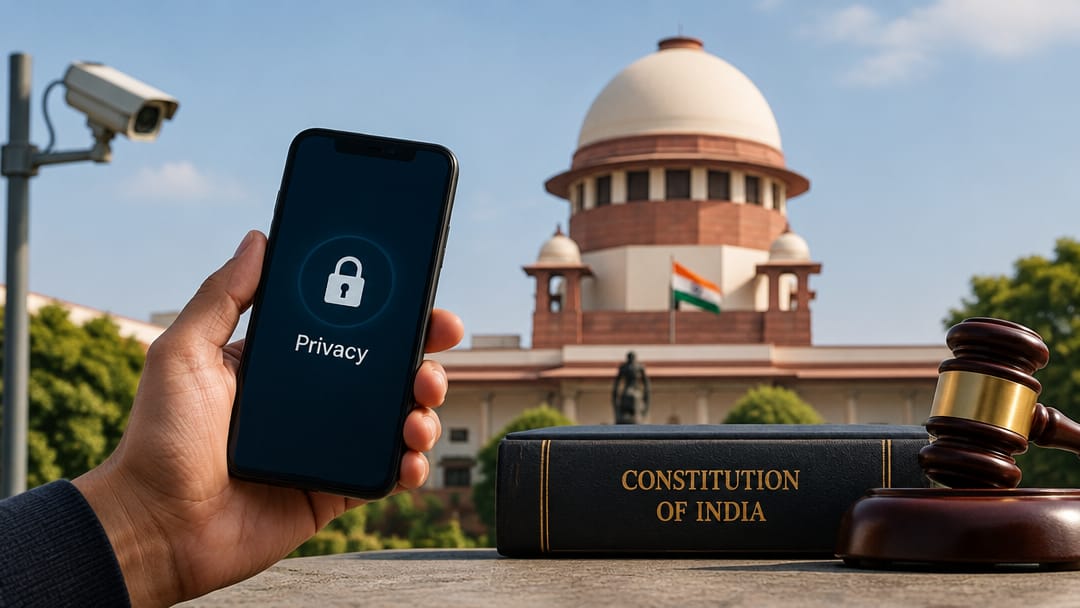
In 2017, a nine-judge Supreme Court bench in Justice K.S. Puttaswamy v. Union of India unanimously held that privacy is a fundamental right under Article 21 of the Constitution, overruling the 1954 M.P. Sharma and 1962 Kharak Singh judgments. The court held that privacy is intrinsic to life and liberty, not a gift of the state. It laid down a three-part test for valid state interference: legality, legitimate aim, and proportionality.
02 Understand
Why it matters
The Puttaswamy judgment is constitutionally significant on three levels.
**The right established:** Privacy under Article 21 is not a standalone right — the court located it at the intersection of Articles 14, 19, and 21, making it part of the golden triangle of fundamental rights. It covers informational privacy, bodily autonomy, decisional autonomy, and identity. This means surveillance, Aadhaar-mandated disclosures, data collection by the state, and sexual orientation laws all engage the right to privacy.
**The limitation recognised:** Privacy is not absolute. The court acknowledged that the state may restrict privacy for legitimate public purposes — national security, public order, health, or welfare. Crucially, privacy must yield to reasonable restrictions, just as Art. 19 rights do.
**The test applied:** The court adopted a three-pronged proportionality test drawn from comparative constitutional law: (1) the restriction must be backed by law (legality); (2) it must pursue a legitimate state aim; and (3) the means must be proportionate to the aim — the least restrictive measure must be used. This test has since been applied in Navtej Singh Johar (decriminalising homosexuality), the Aadhaar judgment (Puttaswamy II, 2018), and Justice Chandrachud's concurrence on adultery in Joseph Shine v. Union of India.
**The overruling:** M.P. Sharma v. Satish Chandra (1954, 8-judge bench) and Kharak Singh v. State of U.P. (1962, 6-judge bench) had held that privacy was not a fundamental right. The 9-judge bench in Puttaswamy expressly overruled both, settling a six-decade constitutional question.
Remember + Why it matters
The key recall facts and exact examiner angle for CLAT PG are in the Crux app.
01
Key figure and date from this topic
02
Specific number or threshold to remember
03
Policy or regulatory implication
Read + Understand free forever · 30-day free trial