01 Read
What happened
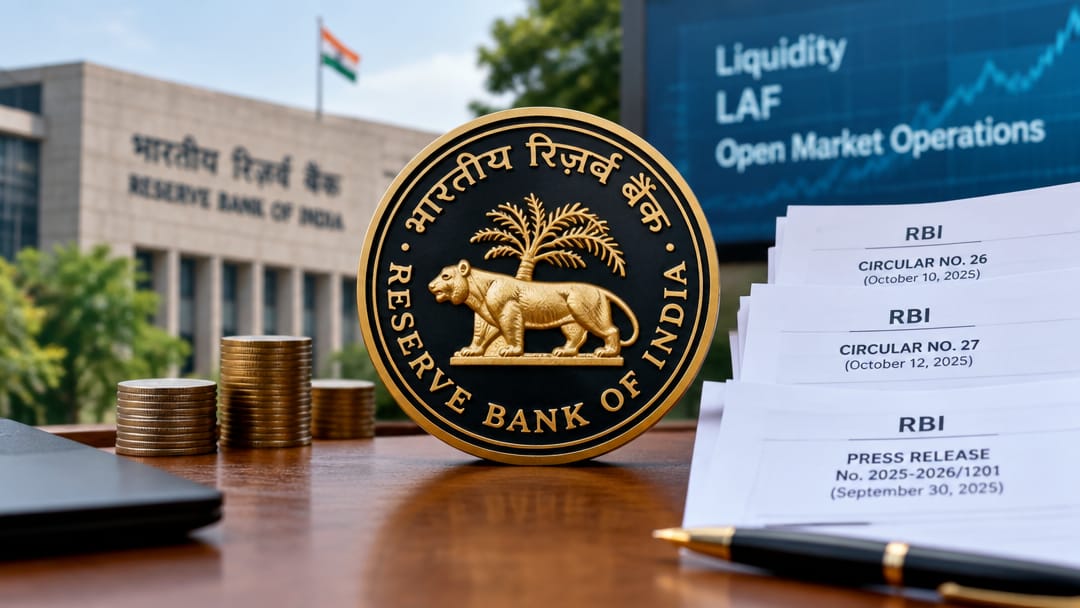
The Reserve Bank of India issued Press Release No. 2025-2026/1201 on September 30, 2025, followed by Circular No. 26 and Circular No. 27 on October 10 and October 12, 2025 respectively, updating money market operations. These circulars govern the Liquidity Adjustment Facility corridor, open market operations, and related instruments through which RBI manages short-term liquidity and transmits monetary policy signals to the broader financial system.
02 Understand
Why it matters
Money market operations are the primary channel through which the RBI's Monetary Policy Committee decisions reach the real economy. The LAF corridor — bounded by the Standing Deposit Facility rate at the floor and the Marginal Standing Facility rate at the ceiling — keeps the weighted average call money rate anchored near the repo rate, which is the policy rate.
When RBI conducts Variable Rate Repo (VRR) auctions, it injects liquidity; Variable Rate Reverse Repo (VRRR) absorbs it. The width of the corridor signals how tightly the RBI wishes to control overnight rates. A narrower corridor (symmetric ±25 bps) indicates precision inflation targeting; a wider corridor gives banks more flexibility but weakens transmission.
Circulars such as these update operational details — eligible collateral, auction timings, cut-off yields, and participation norms — that determine how effectively rate changes pass through to bank lending rates and, ultimately, to credit growth and inflation. For aspirants, the key linkage is: MPC sets repo rate → LAF corridor operationalises it → call money rates align → MCLR adjusts → loan rates change → investment and consumption respond → output and inflation adjust. Every circular that modifies these mechanics is an exam-relevant data point because RBI Grade B questions routinely blank out exact rates, dates, and circular numbers.
Remember + Why it matters
The key recall facts and exact examiner angle for RBI Grade B are in the Crux app.
01
Key figure and date from this topic
02
Specific number or threshold to remember
03
Policy or regulatory implication
Read + Understand free forever · 30-day free trial