01 Read
What happened
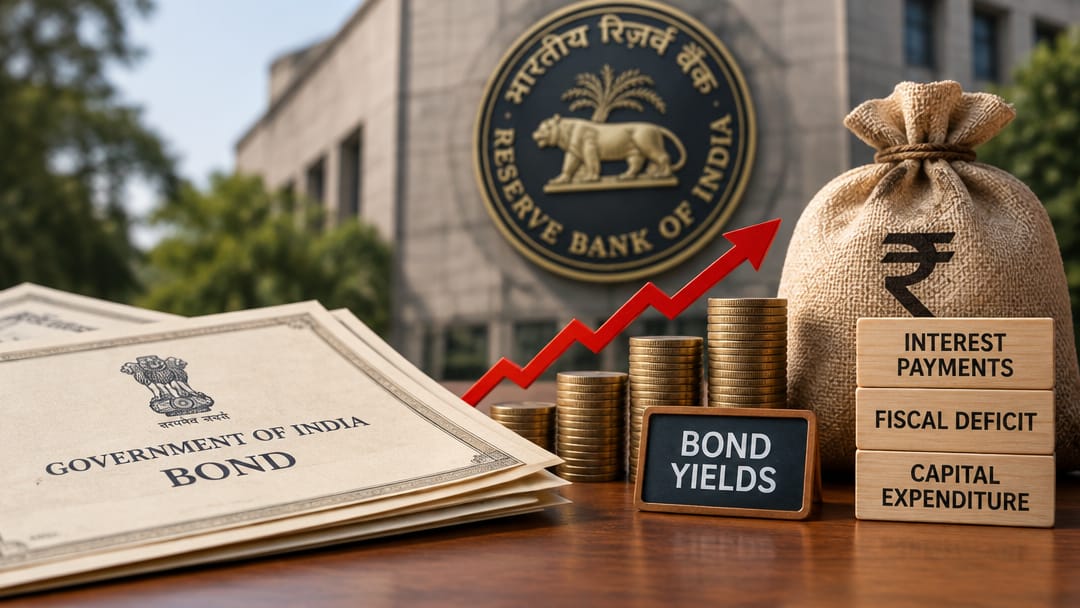
After the RBI's October 2024 monetary policy review, government bond yields have risen sharply, threatening to increase the central government's interest payment burden for the rest of the fiscal year. When yields rise on newly issued or rolled-over debt, the cost of borrowing goes up, squeezing the fiscal deficit target. Higher interest payments crowd out capital expenditure, tightening the government's room to spend on infrastructure and social programmes without breaching the deficit ceiling.
02 Understand
Why it matters
Government bond yields and fiscal arithmetic are tightly linked through a mechanism most aspirants underestimate. When the RBI holds or raises policy rates — or signals a hawkish stance — bond market participants demand higher yields on government securities (G-Secs) to compensate for the expectation that money will remain expensive. The yield on the benchmark 10-year G-Sec is the reference rate for sovereign borrowing cost.
India's central government borrows heavily through dated securities and Treasury Bills throughout the year under a market borrowing programme announced in the Union Budget. When yields rise mid-year — after that programme is already underway — the government must either pay higher coupon rates on fresh issuances or accept higher cut-off yields at weekly auctions. Both outcomes increase the interest outgo beyond what was budgeted.
Interest payments are the single largest item in India's revenue expenditure, consuming over 40 paise of every rupee the government earns in revenue receipts. A sustained yield spike therefore compresses the fiscal space available for discretionary spending. The government faces a trilemma: cut capital expenditure (crowding-out), accept a wider fiscal deficit (breaching the FRBM glide path), or reduce market borrowing (tightening liquidity further).
This connects to the LAF corridor: if the RBI wants to bring yields down it can conduct Open Market Operations (OMO) — purchasing G-Secs from the secondary market — injecting liquidity and pushing prices up (yields down). The absence of such OMOs signals the RBI's tolerance for tighter financial conditions, which is itself a transmission tool for inflation control.
India's central government borrows heavily through dated securities and Treasury Bills throughout the year under a market borrowing programme announced in the Union Budget. When yields rise mid-year — after that programme is already underway — the government must either pay higher coupon rates on fresh issuances or accept higher cut-off yields at weekly auctions. Both outcomes increase the interest outgo beyond what was budgeted.
Interest payments are the single largest item in India's revenue expenditure, consuming over 40 paise of every rupee the government earns in revenue receipts. A sustained yield spike therefore compresses the fiscal space available for discretionary spending. The government faces a trilemma: cut capital expenditure (crowding-out), accept a wider fiscal deficit (breaching the FRBM glide path), or reduce market borrowing (tightening liquidity further).
This connects to the LAF corridor: if the RBI wants to bring yields down it can conduct Open Market Operations (OMO) — purchasing G-Secs from the secondary market — injecting liquidity and pushing prices up (yields down). The absence of such OMOs signals the RBI's tolerance for tighter financial conditions, which is itself a transmission tool for inflation control.
Remember + Why it matters
The key recall facts and exact examiner angle for SEBI Grade A are in the Crux app.
01
Key figure and date from this topic
02
Specific number or threshold to remember
03
Policy or regulatory implication
Read + Understand free forever · 30-day free trial