01 Read
What happened
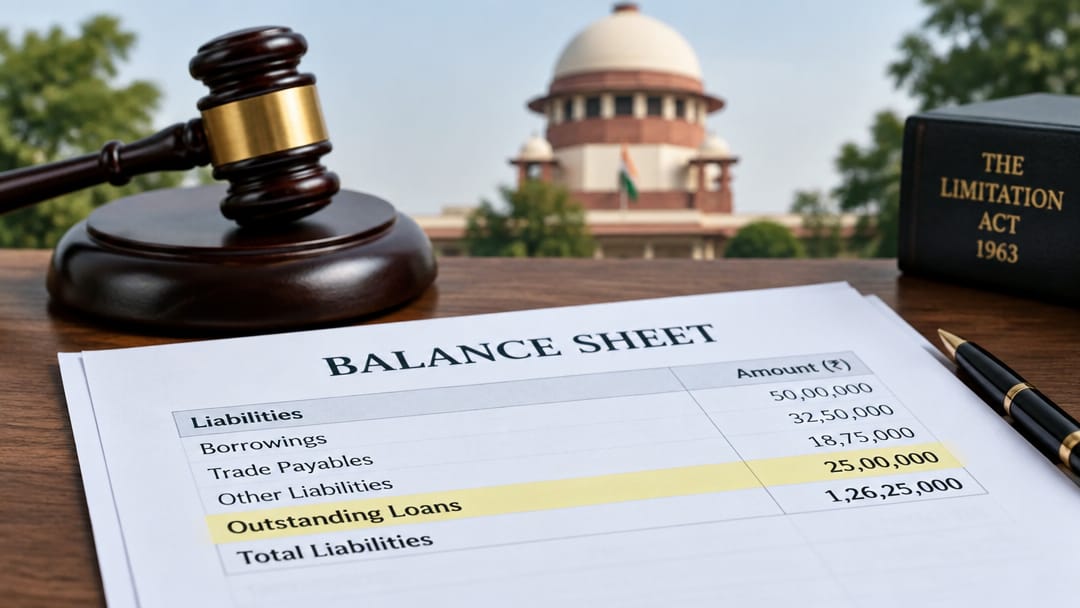
The Supreme Court held that entries recorded in a company's balance sheet can constitute an acknowledgment of liability under Section 18 of the Limitation Act, 1963, thereby extending the period of limitation for filing a suit. The ruling restored a money recovery suit that had been dismissed as time-barred. The court reasoned that a balance sheet entry, if it admits an outstanding debt, satisfies the legal requirements of acknowledgment even without a separate signed document.
02 Understand
Why it matters
Section 18 of the Limitation Act, 1963 provides that if a person acknowledges liability in respect of any property or right before the limitation period expires, a fresh period of limitation begins from the date of acknowledgment. The acknowledgment must be in writing and signed by the party or their agent.
The Supreme Court's ruling addresses a commercially significant question: does a balance sheet entry — which is not a standalone acknowledgment letter but an accounting document signed by company directors — satisfy Section 18? The Court held that it does, provided the entry clearly reflects an admission of an outstanding debt.
This matters because companies routinely record outstanding liabilities in their balance sheets, and creditors sometimes discover a debt is time-barring only after several years. If the debtor's own audited balance sheet records the liability, that entry can serve as acknowledgment, giving the creditor a fresh limitation period from the date of the balance sheet.
The key doctrinal elements are: (1) the acknowledgment must be before the original period expires; (2) it must be in writing; (3) it must be signed — balance sheets signed by directors satisfy this; and (4) it must acknowledge the specific liability, not merely refer to accounts generally. This aligns with the broader principle that acknowledgment need not be a formal admission — an implied recognition of subsisting liability is sufficient.
The Supreme Court's ruling addresses a commercially significant question: does a balance sheet entry — which is not a standalone acknowledgment letter but an accounting document signed by company directors — satisfy Section 18? The Court held that it does, provided the entry clearly reflects an admission of an outstanding debt.
This matters because companies routinely record outstanding liabilities in their balance sheets, and creditors sometimes discover a debt is time-barring only after several years. If the debtor's own audited balance sheet records the liability, that entry can serve as acknowledgment, giving the creditor a fresh limitation period from the date of the balance sheet.
The key doctrinal elements are: (1) the acknowledgment must be before the original period expires; (2) it must be in writing; (3) it must be signed — balance sheets signed by directors satisfy this; and (4) it must acknowledge the specific liability, not merely refer to accounts generally. This aligns with the broader principle that acknowledgment need not be a formal admission — an implied recognition of subsisting liability is sufficient.
Remember + Why it matters
The key recall facts and exact examiner angle for CLAT PG are in the Crux app.
01
Key figure and date from this topic
02
Specific number or threshold to remember
03
Policy or regulatory implication
Read + Understand free forever · 30-day free trial