01 Read
What happened
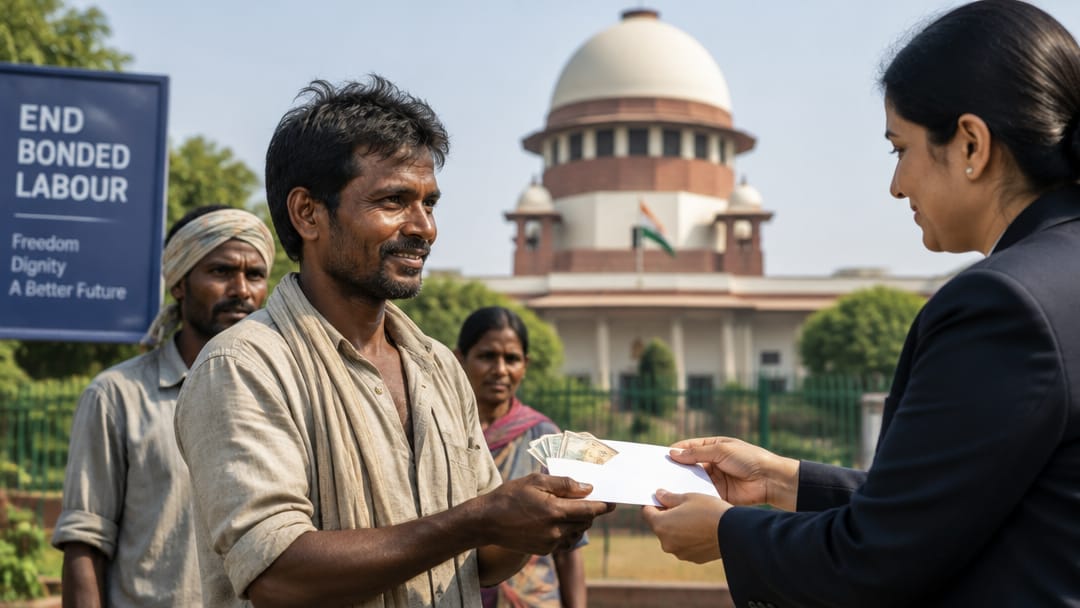
The Supreme Court issued pan-India directions mandating that financial assistance for rescued bonded labourers must be disbursed within seven days of release. The ruling reinforces that delayed rehabilitation effectively denies the right guaranteed under Article 21 and the Bonded Labour System (Abolition) Act, 1976. The Court directed district authorities and state governments to ensure prompt payment of rehabilitation grants, treating unreasonable delay as a violation of the freed labourer's fundamental right to life and dignity.
02 Understand
Why it matters
Bonded labour — where a person is compelled to work to repay a debt — is both a form of forced labour and a denial of personal liberty. Article 23 of the Constitution expressly prohibits traffic in human beings and forced labour, making it a Fundamental Right enforceable against the State. The Bonded Labour System (Abolition) Act, 1976 gives statutory teeth to Article 23: it extinguishes the bonded debt ipso facto upon commencement, criminalises enforcement of bonded labour, and mandates rehabilitation through the Centrally Sponsored Scheme.
The Supreme Court has long treated rehabilitation as integral to, not separate from, liberation. In Bandhua Mukti Morcha v. Union of India (1984), the Court held that bonded labourers are entitled to the benefit of all labour laws and social welfare legislation, and that the State's obligation does not end with rescue. This ruling extended Article 21's right to live with dignity into the rehabilitation phase itself.
The 2025–26 directions go further: they set a hard seven-day timeline for financial assistance. The doctrinal move here is significant — the Court is treating administrative delay as a constitutional violation, not merely an administrative lapse. This echoes the principle from Arnab Goswami (2020) that 'the deprivation of liberty even for a single day is one day too many,' transposed now to the socio-economic rights context: delay in restoring dignity equals denial of dignity.
For CLAT PG, the examiner will test whether you can apply Article 21 and Article 23 together, identify the correct statute, and distinguish the Court's role in Bandhua Mukti Morcha from later cases like People's Union for Democratic Rights v. Union of India (1982), which first interpreted 'forced labour' under Article 23.
Remember + Why it matters
The key recall facts and exact examiner angle for UPSC CSE are in the Crux app.
01
Key figure and date from this topic
02
Specific number or threshold to remember
03
Policy or regulatory implication
Read + Understand free forever · 30-day free trial