01 Read
What happened
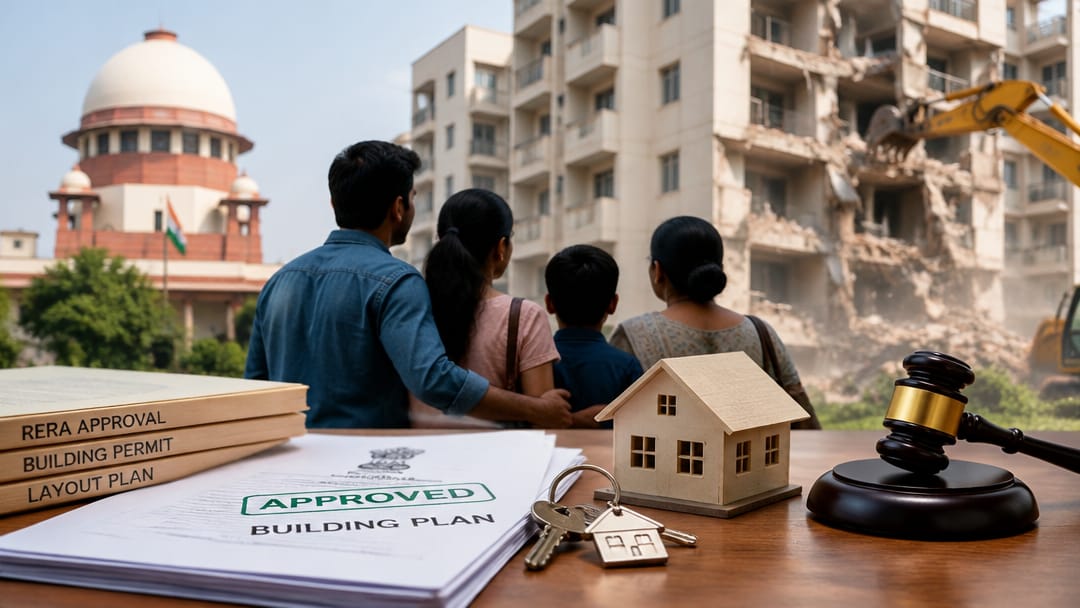
The Supreme Court ruled that flat buyers who purchased homes relying on government-issued approvals and official documents cannot be penalised for a builder's unauthorised construction. Before any demolition proceeds, the state must provide an alternative site or accommodation to affected residents. The Court held that innocent purchasers acting in good faith deserve protection under Article 300A, which guarantees that no person shall be deprived of property except by authority of law and with due process.
02 Understand
Why it matters
This ruling sits at the intersection of Article 300A (right to property) and the doctrine of legitimate expectation rooted in Articles 14 and 21. After the 44th Constitutional Amendment (1978) removed the right to property from Part III, Article 300A became the sole constitutional shelter for property rights — but the Supreme Court has progressively expanded its content.
The Court has held, beginning with Vidya Devi v. State of H.P. (2020) and reiterated in multiple benches, that Article 300A is not a mere procedural shell. It contains substantive guarantees: (1) the deprivation must be by 'authority of law' — not mere executive action; (2) the law must be just, fair, and reasonable (importing Article 21's due-process standard); and (3) the State must pay compensation or provide an equivalent remedy.
The present ruling adds a fourth dimension — the bona fide purchaser principle. Where a buyer relies on officially granted approvals (completion certificates, occupancy certificates, registered sale deeds), the State cannot demolish without first securing alternative accommodation. This is an application of the estoppel doctrine against the State: the government cannot resile from representations made through its own regulatory approvals to the detriment of innocent third parties.
For CLAT PG, the key doctrinal chain is: Art. 31 (repealed 1978) → Art. 300A → Vidya Devi (2020) → Kolkata Municipal Corp. cases → present ruling. The examiner tests whether aspirants can distinguish the right, the limitation, and the test — and apply them to new fact patterns involving demolition, acquisition, or dispossession.
Remember + Why it matters
The key recall facts and exact examiner angle for CLAT PG are in the Crux app.
01
Key figure and date from this topic
02
Specific number or threshold to remember
03
Policy or regulatory implication
Read + Understand free forever · 30-day free trial