01 Read
What happened
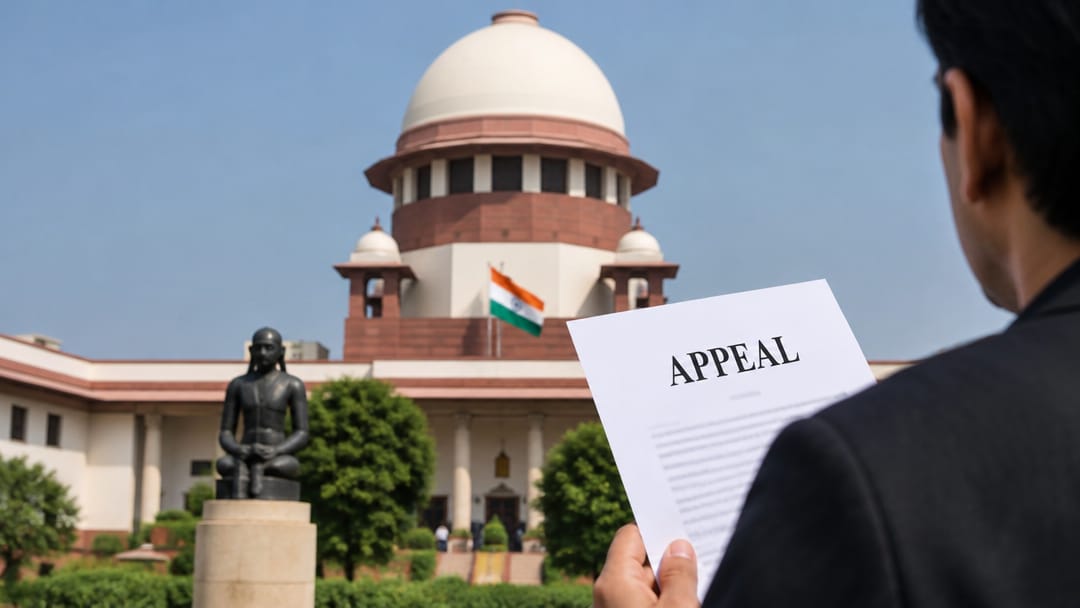
The Supreme Court on October 30 reiterated that a person who is not a party to a suit — a 'stranger' or third party — is not barred from appealing a consent decree if they can demonstrate that the decree prejudicially affects their interests. The ruling reinforces a settled but frequently overlooked principle: a consent decree, though agreed upon by the original parties, cannot bind or harm a non-party who had no voice in its making.
02 Understand
Why it matters
A consent decree is a court order recording a compromise reached between the parties to a suit under Order XXIII Rule 3 of the Code of Civil Procedure, 1908. Because it flows from mutual agreement rather than adjudication, courts have sometimes assumed it cannot be questioned. The Supreme Court's restatement corrects that assumption for third parties.
The foundational rule is that a consent decree binds only the parties to the compromise. It cannot, by its own force, extinguish the rights of a stranger — a person who was neither a plaintiff nor a defendant in the original suit. If such a stranger can show that the decree, despite being a product of consent between others, operates to their prejudice — for instance, by settling a property dispute in a way that encroaches on their title or extinguishes their interest — they retain the right to challenge it in appeal.
The doctrinal basis connects to the privity principle: a person not party to a proceeding ordinarily cannot be bound by its outcome. This mirrors the contract-law rule that only parties to a contract can sue on it (privity of contract under Section 2(h) of the Indian Contract Act). A consent decree is essentially a contractual settlement elevated to a court order; the elevation does not cure the absence of consent from affected non-parties.
For CLAT PG, the examiner tests whether aspirants can distinguish (a) a party challenging a consent decree — which requires showing fraud, misrepresentation, or a vitiating factor under Order XXIII Rule 3A — from (b) a stranger challenging it — which requires only proof of prejudice. The two routes and their distinct conditions are the core testable distinction.
Remember + Why it matters
The key recall facts and exact examiner angle for CLAT PG are in the Crux app.
01
Key figure and date from this topic
02
Specific number or threshold to remember
03
Policy or regulatory implication
Read + Understand free forever · 30-day free trial