01 Read
What happened
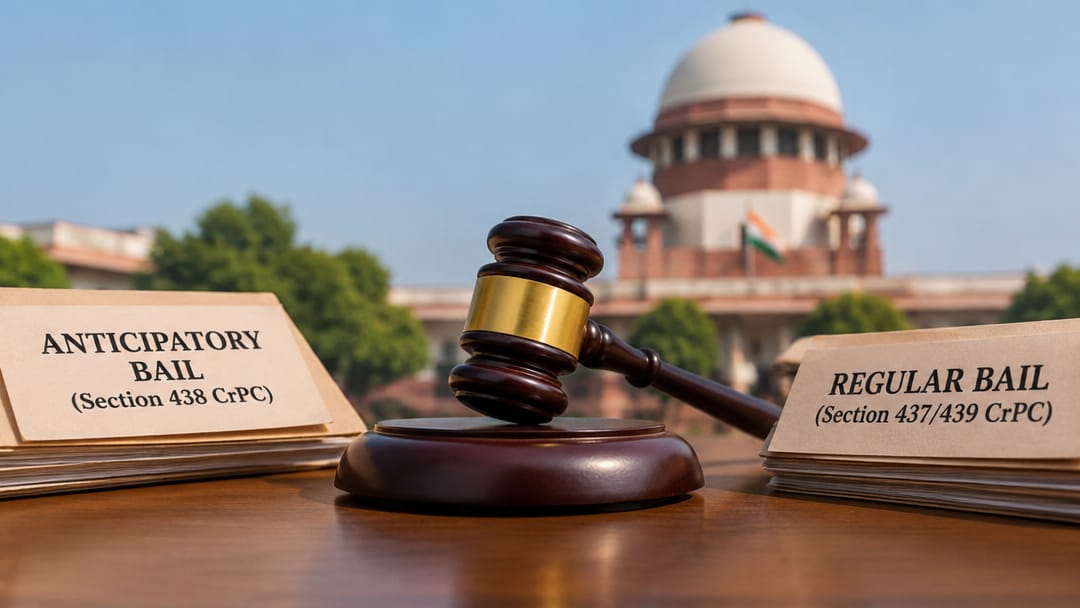
The Supreme Court set aside an Orissa High Court order that denied anticipatory bail in a murder case but simultaneously directed the trial court to grant regular bail on predetermined conditions. The Supreme Court held that this practice is legally impermissible — a court rejecting anticipatory bail under Section 438 CrPC cannot usurp the trial court's independent jurisdiction by pre-fixing conditions for regular bail under Section 437 or 439 CrPC. Each bail application must be decided on its own merits.
02 Understand
Why it matters
This ruling clarifies a critical boundary between two distinct bail jurisdictions under the CrPC (now mirrored in BNSS 2023).
Anticipatory bail under Section 438 CrPC (Section 482 BNSS) is pre-arrest protection granted by a Sessions Court or High Court when a person apprehends arrest. Regular bail under Section 437 (Magistrate) or Section 439 CrPC (Sessions Court/High Court) operates post-arrest, after the accused is taken into custody.
The Orissa High Court's order attempted a hybrid: it refused anticipatory bail but simultaneously told the trial court to grant regular bail if the accused was arrested, subject to conditions the HC itself specified. The Supreme Court found this legally untenable for two reasons.
First, it conflates two separate jurisdictions. The power to grant regular bail belongs to the court before which the accused appears after arrest. That court must independently assess flight risk, evidence tampering potential, severity of offence, and other factors at that stage — it cannot be pre-empted by a higher court deciding a different application.
Second, such a direction amounts to the High Court exercising Section 439 jurisdiction preemptively and in the abstract, without the accused actually being in custody — which is the precondition for Section 439 to operate.
For CLAT PG, the key principle is jurisdictional separateness: anticipatory bail and regular bail are not a continuum but distinct remedies with different preconditions, different courts of primary jurisdiction, and independent discretion at each stage.
Remember + Why it matters
The key recall facts and exact examiner angle for CLAT PG are in the Crux app.
01
Key figure and date from this topic
02
Specific number or threshold to remember
03
Policy or regulatory implication
Read + Understand free forever · 30-day free trial