01 Read
What happened
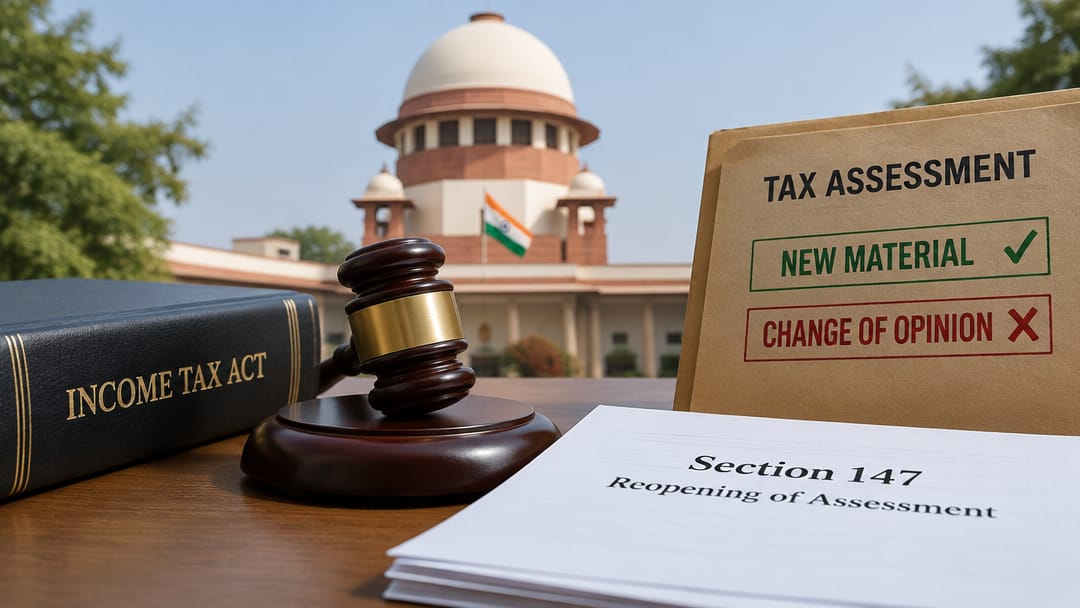
The Supreme Court ruled that a tax assessment under Section 147 of the Income Tax Act can be reopened on fresh material showing escaped income, but only if the Assessing Officer had not already formed an opinion on that issue during the original assessment. If an opinion was formed earlier, reopening amounts to a review of a concluded decision, which is impermissible. The ruling draws a clear line between reassessment based on new facts and impermissible change of opinion.
02 Understand
Why it matters
Section 147 of the Income Tax Act empowers the Assessing Officer to reopen a completed assessment if they have 'reason to believe' that income chargeable to tax has escaped assessment. However, judicial interpretation has consistently held that this power is not unlimited — it cannot be used as a second look at the same material already examined.
The Supreme Court's ruling crystallises the distinction between two situations: (1) where fresh tangible material surfaces that was not before the AO during the original assessment, and (2) where the AO simply changes their mind on material already examined. Only the first justifies reopening.
The critical condition is whether an 'opinion was formed' in the first instance. If the AO applied their mind to a particular issue and took a conscious position — even by not making an addition — reopening on the same facts is a review, not a reassessment. This is the doctrine against 'change of opinion,' recognised in landmark cases like CIT v. Kelvinator of India Ltd. (2010) 2 SCC 723.
For CLAT PG aspirants, this matters because the examiner frequently uses tax-law passages to test the ability to apply a restrictive statutory interpretation. The principle — power exists but is conditioned by prior non-application of mind — maps onto a broader jurisprudential theme: administrative and quasi-judicial powers cannot be used to review one's own earlier reasoned decisions.
The Supreme Court's ruling crystallises the distinction between two situations: (1) where fresh tangible material surfaces that was not before the AO during the original assessment, and (2) where the AO simply changes their mind on material already examined. Only the first justifies reopening.
The critical condition is whether an 'opinion was formed' in the first instance. If the AO applied their mind to a particular issue and took a conscious position — even by not making an addition — reopening on the same facts is a review, not a reassessment. This is the doctrine against 'change of opinion,' recognised in landmark cases like CIT v. Kelvinator of India Ltd. (2010) 2 SCC 723.
For CLAT PG aspirants, this matters because the examiner frequently uses tax-law passages to test the ability to apply a restrictive statutory interpretation. The principle — power exists but is conditioned by prior non-application of mind — maps onto a broader jurisprudential theme: administrative and quasi-judicial powers cannot be used to review one's own earlier reasoned decisions.
Remember + Why it matters
The key recall facts and exact examiner angle for CLAT PG are in the Crux app.
01
Key figure and date from this topic
02
Specific number or threshold to remember
03
Policy or regulatory implication
Read + Understand free forever · 30-day free trial