01 Read
What happened
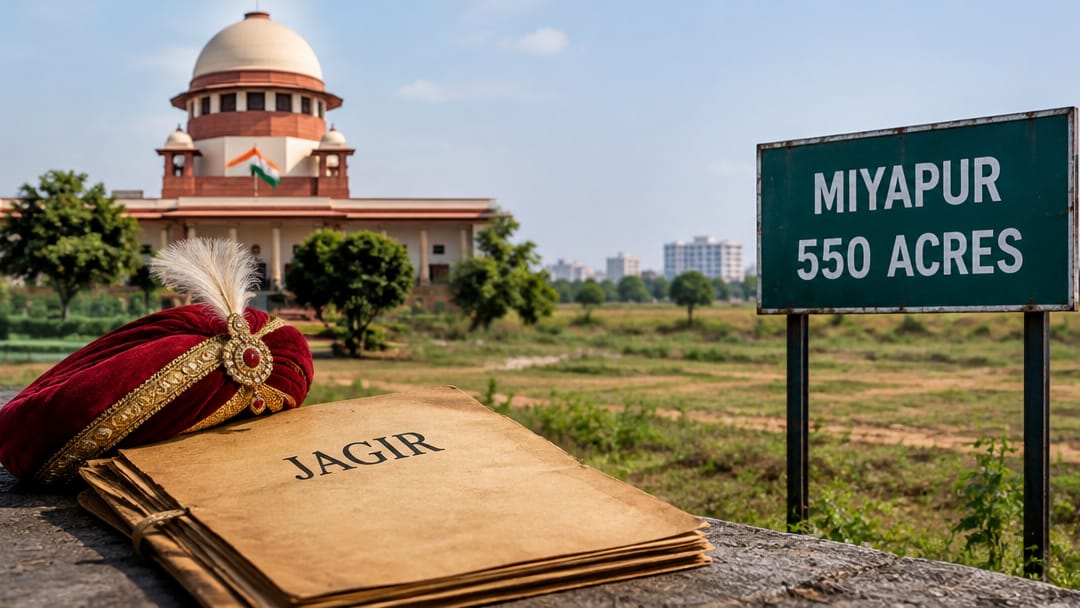
The Supreme Court on 29 October 2024 dismissed appeals by claimants seeking title over approximately 550 acres of land in Miyapur, Telangana. The Court held that jagirdars never held full proprietary title to the land; their rights were abolished under Hyderabad-era land reform legislation. Upon abolition, the land vested absolutely in the government. No succession, sale, or gift by the jagirdar could transfer what was never privately owned.
02 Understand
Why it matters
This ruling turns on the doctrine of 'vesting by operation of law' — a constitutional and statutory mechanism central to land reform jurisprudence in India.
Background: After Independence, the Hyderabad State enacted the Hyderabad (Abolition of Jagirs) Regulation, 1358 Fasli (1949), which abolished the jagir system. A jagir was not private ownership; it was a revenue assignment by the sovereign. The jagirdar collected land revenue but held no absolute proprietary title. The Regulation extinguished even that limited right, and the land vested in the State.
Constitutional Interface: The Ninth Schedule of the Constitution protects land reform laws from challenge under Articles 14, 19, and 31 (now Article 300A). The 1st Constitutional Amendment (1951) inserted Articles 31A and 31B specifically to shield agrarian reform legislation from property-rights challenges. This means jagirs abolished before or after the Constitution cannot be challenged on the ground that private property was taken without compensation under Article 300A once the Ninth Schedule protection applies.
Test Applied: The Court applied a two-part inquiry — (1) Did the jagirdar ever hold a proprietary title cognisable in law? (2) If not, can heirs claim succession to a title that never existed? The answer to both was no. The doctrine of 'nemo dat quod non habet' (one cannot give what one does not have) completes the reasoning: the jagirdar could not pass on title by succession or alienation.
Broader Principle: Escheat and bona vacantia are separate but related doctrines (Article 296). Here the mechanism was statutory vesting, not escheat — an important distinction the examiner may probe.
Remember + Why it matters
The key recall facts and exact examiner angle for CLAT PG are in the Crux app.
01
Key figure and date from this topic
02
Specific number or threshold to remember
03
Policy or regulatory implication
Read + Understand free forever · 30-day free trial