01 Read
What happened
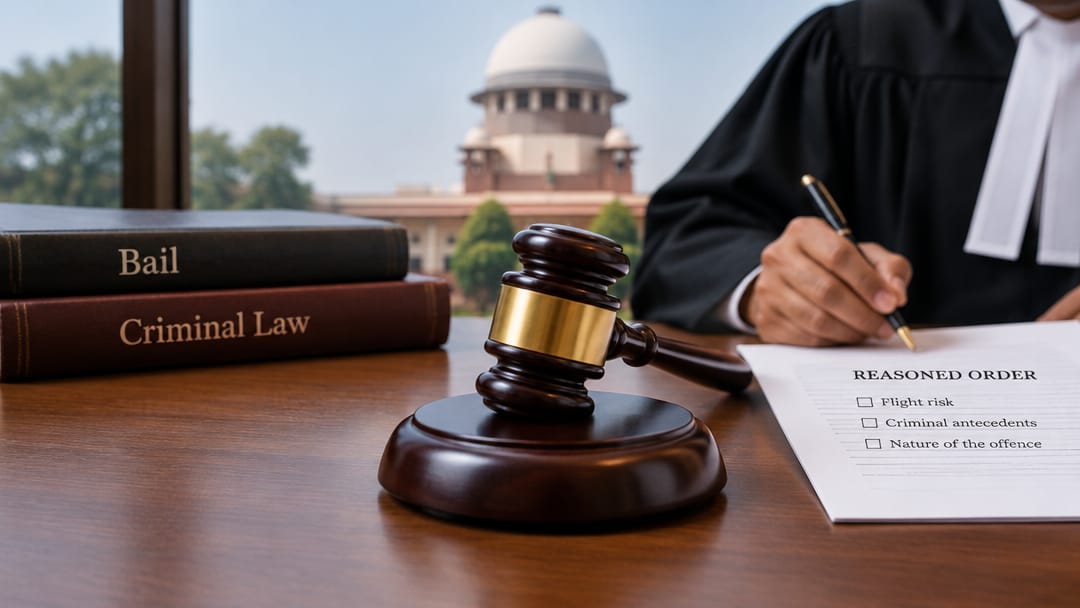
The Supreme Court, in Ramprakash Rajagopal, held that bail orders must contain independent judicial reasoning and cannot merely reproduce submissions made by the parties. A court granting or refusing bail must apply its own mind to the relevant factors — flight risk, criminal antecedents, nature of the offence — and record why it is satisfied or not satisfied. Recording what lawyers argued, without analysing those arguments, does not constitute a reasoned order.
02 Understand
Why it matters
Bail is the rule, jail is the exception — a principle the Supreme Court has affirmed repeatedly — but that principle is only operational if the bail order itself is reasoned. In Ramprakash Rajagopal, the Court addressed a systemic problem: courts routinely pass bail orders that do little more than list the submissions of both sides and then state a conclusion. Such orders are legally deficient.
The requirement of a reasoned order is not merely procedural. It serves three functions: (i) it disciplines the judicial mind to actually weigh competing considerations; (ii) it enables a higher court to meaningfully examine whether the discretion was properly exercised on appeal or revision; and (iii) it protects personal liberty by ensuring that deprivation of freedom is not the product of an unexamined mechanical exercise.
Under the CrPC (Section 437, 439) and the BNSS (Sections 479, 483), bail is a discretionary remedy. But discretion must be structured. The classic factors — nature and gravity of the accusation, antecedents of the accused, possibility of fleeing justice, and likelihood of tampering with evidence — must actually be weighed, not merely enumerated. This ruling also connects to the broader line of cases (Arnesh Kumar, Satender Kumar Antil) where the Court has pushed back against mechanical incarceration. CLAT PG passages in this area frequently excerpt such rulings and ask applicants to identify what the court held versus what was merely argued.
Remember + Why it matters
The key recall facts and exact examiner angle for CLAT PG are in the Crux app.
01
Key figure and date from this topic
02
Specific number or threshold to remember
03
Policy or regulatory implication
Read + Understand free forever · 30-day free trial