01 Read
What happened
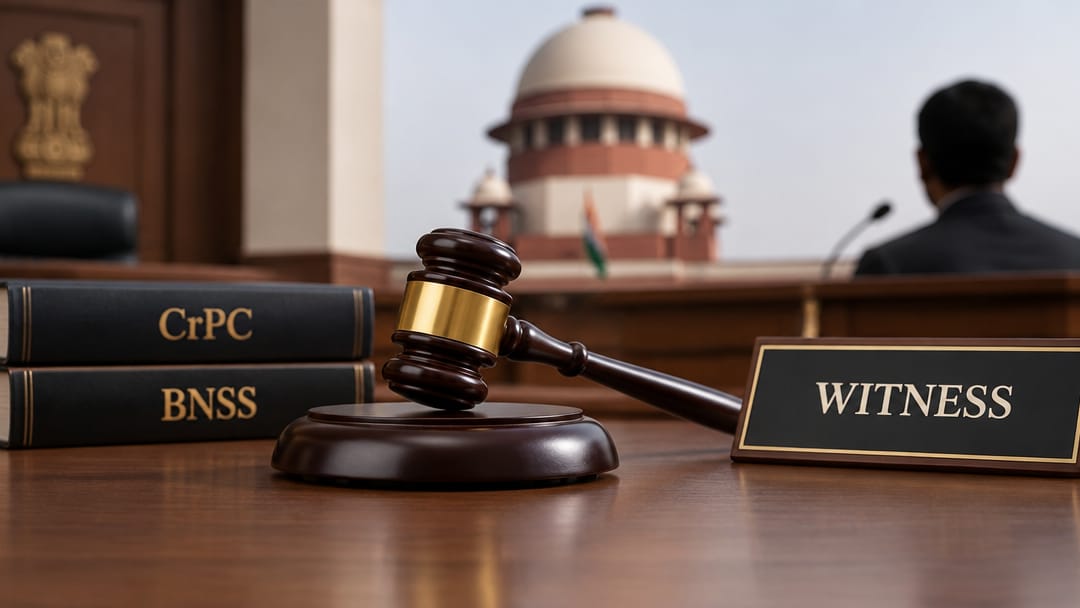
The Supreme Court has held that when a court exercises its power under Section 311 CrPC — now Section 348 of the BNSS — to summon a witness or recall evidence it considers necessary for a just decision, it cannot impose costs on any party as a condition. The power under Section 311 is discretionary but once the court finds the evidence essential, costs become impermissible. This ruling clarifies the limits of judicial discretion at the intersection of evidence-gathering and procedural fairness.
02 Understand
Why it matters
Section 311 CrPC (now Section 348 BNSS) grants courts a wide, almost plenary power to summon any person as a witness, examine any person already present in court, or recall and re-examine any witness already examined — at any stage of a trial, inquiry, or other proceeding. The critical feature of this section is its dual character: the first part is mandatory ('shall') when the evidence is essential to a just decision; the second part is discretionary ('may') for general purposes of justice.
The Supreme Court's ruling resolves a practical confusion: can courts impose costs — say, requiring the party who benefits from additional evidence to pay the other side's expenses — when exercising this power? The answer is no, at least when the court itself has found the evidence necessary for a just decision. The rationale is that when a court acts under the mandatory limb of Section 311, it acts in the interest of justice itself, not in the interest of any party. Imposing costs would create a chilling effect, deterring courts from exercising a power the legislature made mandatory.
For CLAT PG aspirants, this ruling sits at the intersection of two frequently tested themes: the scope of judicial discretion under Section 311/348, and the principle that procedural powers aimed at truth-finding cannot be weaponised as cost-imposing tools. The transition from CrPC to BNSS also means aspirants must know both the old and new section numbers, as CLAT PG examiners have already begun testing BNSS provisions alongside legacy CrPC references.
Remember + Why it matters
The key recall facts and exact examiner angle for CLAT PG are in the Crux app.
01
Key figure and date from this topic
02
Specific number or threshold to remember
03
Policy or regulatory implication
Read + Understand free forever · 30-day free trial