01 Read
What happened
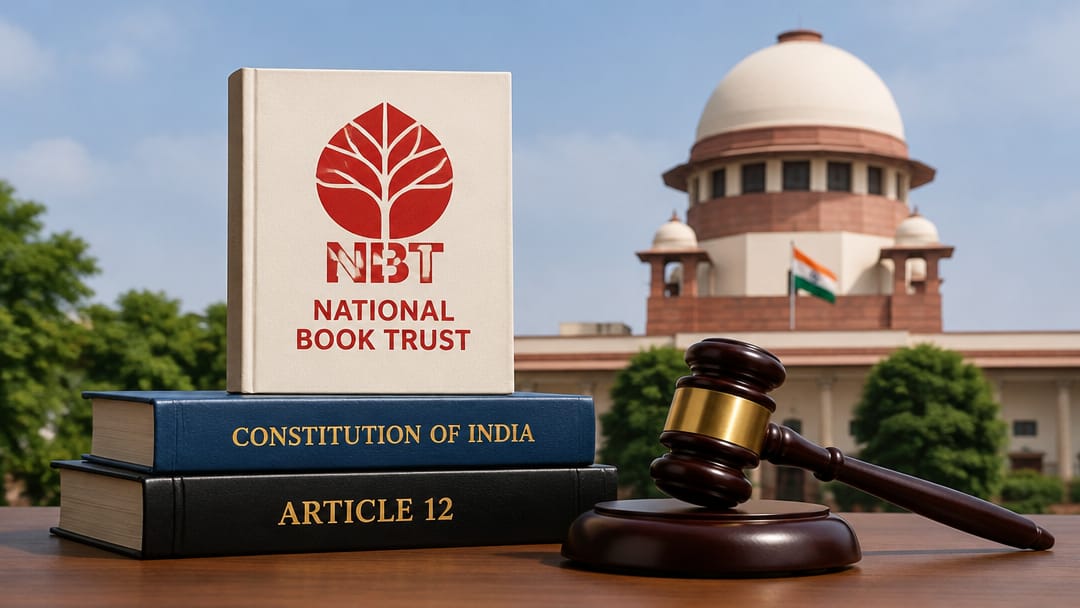
The Supreme Court has ruled that the National Book Trust qualifies as 'State' under Article 12 of the Constitution because the central government exercises deep and pervasive control over it. This means NBT employees and individuals aggrieved by its decisions can now directly enforce fundamental rights against it through writ petitions. The Delhi High Court had previously taken a contrary view, which the Supreme Court has now overturned in this ruling.
02 Understand
Why it matters
Article 12 of the Constitution defines 'State' for the purpose of Part III (Fundamental Rights). It expressly includes the Government of India, Parliament, state governments, legislatures, and 'other authorities' within Indian territory or under government control. The phrase 'other authorities' has been judicially expanded over decades through a series of landmark rulings.
The evolution runs as follows: In Rajasthan SEB v. Mohan Lal (1967), the Supreme Court held that 'other authorities' includes statutory bodies exercising governmental functions. In Sukhdev Singh v. Bhagatram (1975), statutory corporations like ONGC, LIC, and IFC were held to be 'State.' The critical test crystallised in Ajay Hasia v. Khalid Mujib (1981), where a six-factor test was laid down — now the standard framework — asking whether: (1) the entire share capital is held by government; (2) financial assistance from the State meets almost all expenditure; (3) the body enjoys a monopoly status conferred by the State; (4) a deep and pervasive State control exists; (5) the functions discharged are of a public importance; (6) a government department has been transferred to the body.
The NBT is a trust established by the Ministry of Education. It is not a statutory corporation, but the Court applied the Ajay Hasia test and found that government funding, governmental appointment of its chairman and governing body, and State supervision of its objectives satisfied the 'deep and pervasive control' criterion. This overrules the Delhi HC and confirms that even non-statutory bodies can be 'State' if governmental control is structural and not merely incidental.
Remember + Why it matters
The key recall facts and exact examiner angle for UPSC CSE are in the Crux app.
01
Key figure and date from this topic
02
Specific number or threshold to remember
03
Policy or regulatory implication
Read + Understand free forever · 30-day free trial