01 Read
What happened
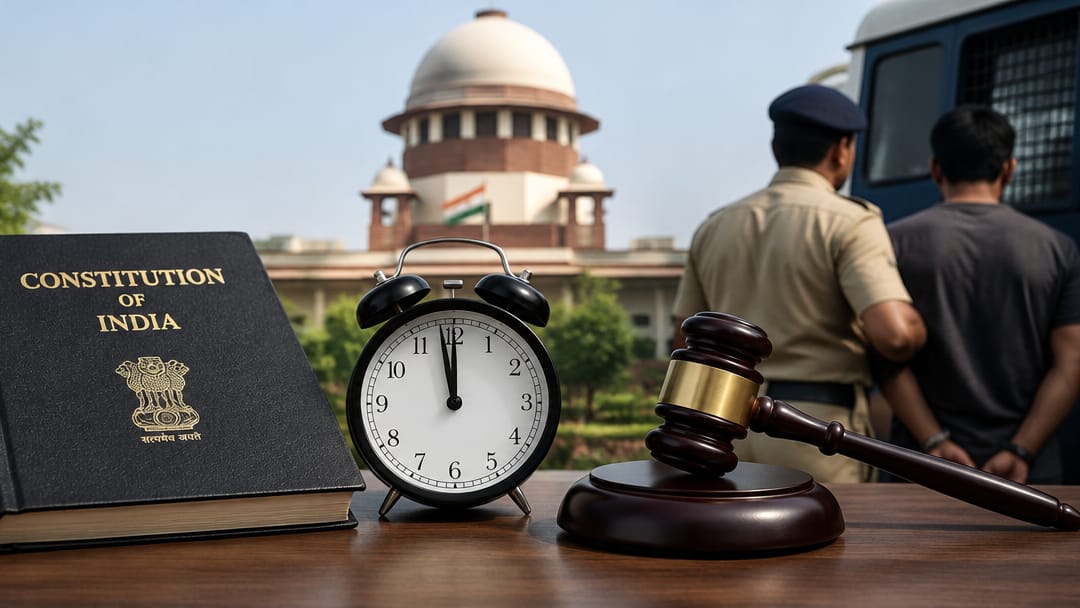
The Supreme Court has held that the 24-hour deadline under Article 22(2) of the Constitution begins the moment a person's liberty is actually curtailed, not when an investigating agency formally records an arrest. The Court rejected the concept of 'informal detention', ruling that police cannot hold a person incommunicado or restrict movement without triggering constitutional safeguards. Agencies must produce such a person before a magistrate within 24 hours of actual curtailment of liberty.
02 Understand
Why it matters
Article 22 of the Constitution provides procedural safeguards against arbitrary arrest and detention. Article 22(1) guarantees the right to be informed of grounds of arrest and to consult a legal practitioner. Article 22(2) mandates production before the nearest magistrate within 24 hours of arrest, excluding travel time.
The core legal issue this ruling resolves is the definitional question: when does the 24-hour clock begin? Investigating agencies had, in practice, used 'informal detention' — keeping a person in custody without formally recording the arrest — to circumvent this timeline. The Court firmly rejected this evasion, holding that the constitutional clock starts at the moment of actual curtailment of liberty, regardless of whether the agency has formally labelled it as an arrest.
This ruling builds on D.K. Basu v. State of West Bengal (1997), which laid down binding guidelines for arrest, including the requirement to inform a friend or relative and to prepare an arrest memo. It also resonates with Arnesh Kumar v. State of Bihar (2014), where the Court cautioned against casual arrests, particularly in cognisable offences carrying less than seven years' imprisonment.
The constitutional architecture here is clear: Article 21 (right to life and personal liberty) and Article 22 operate together. Any deprivation of liberty must follow the procedure established by law, and that procedure includes the 24-hour magistrate production rule. By anchoring the timeline to actual, factual curtailment of liberty rather than formal arrest paperwork, the Court closes a significant loophole that had been exploited in practice.
Remember + Why it matters
The key recall facts and exact examiner angle for CLAT PG are in the Crux app.
01
Key figure and date from this topic
02
Specific number or threshold to remember
03
Policy or regulatory implication
Read + Understand free forever · 30-day free trial