01 Read
What happened
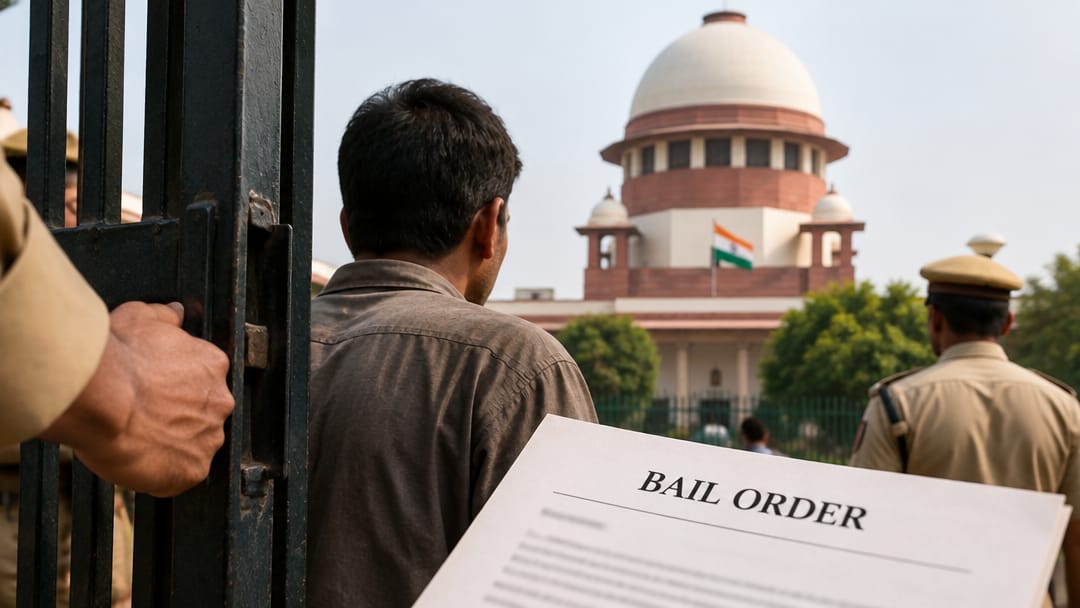
The Supreme Court has held that the State of Uttar Pradesh bears direct responsibility for ensuring undertrials who have been granted bail are actually released from custody. The Court directed the state to make bail conditions flexible and to ensure legal aid reaches those who cannot afford to comply with standard surety requirements. The ruling targets the gap between a court granting bail and the undertrial physically walking free — a gap the Court said the state must close.
02 Understand
Why it matters
Bail in India operates on a simple premise: an accused is presumed innocent until proven guilty, and pre-trial detention should be the exception, not the rule. Yet in practice, thousands of undertrial prisoners remain in jail even after a court has granted them bail — not because they lost the application, but because they cannot meet the conditions attached to it, chiefly furnishing sureties or depositing bail bonds.
The Supreme Court's ruling against Uttar Pradesh addresses this structural failure. By placing the onus on the state government — rather than leaving it to the undertrial to navigate the system alone — the Court is enforcing the principle established in Arnesh Kumar v. State of Bihar (2014) and reinforced in Satender Kumar Antil v. CBI (2022): that liberty is the rule and custody is the exception.
Section 436A of CrPC (Section 479 BNSS) allows an undertrial who has served half the maximum sentence for the offence to be released on bail. Section 440 empowers courts to reduce the amount of surety. The problem is that these provisions exist on paper but go unused when no one — counsel, state, or court — takes responsibility for implementation.
This ruling is significant because it converts a passive judicial permission (bail granted) into an active state obligation (ensure release). It connects to Articles 21 and 22 of the Constitution — right to life and personal liberty — and to the ongoing discourse on prison reform and undertrial rights in India.
Remember + Why it matters
The key recall facts and exact examiner angle for CLAT PG are in the Crux app.
01
Key figure and date from this topic
02
Specific number or threshold to remember
03
Policy or regulatory implication
Read + Understand free forever · 30-day free trial