01 Read
What happened
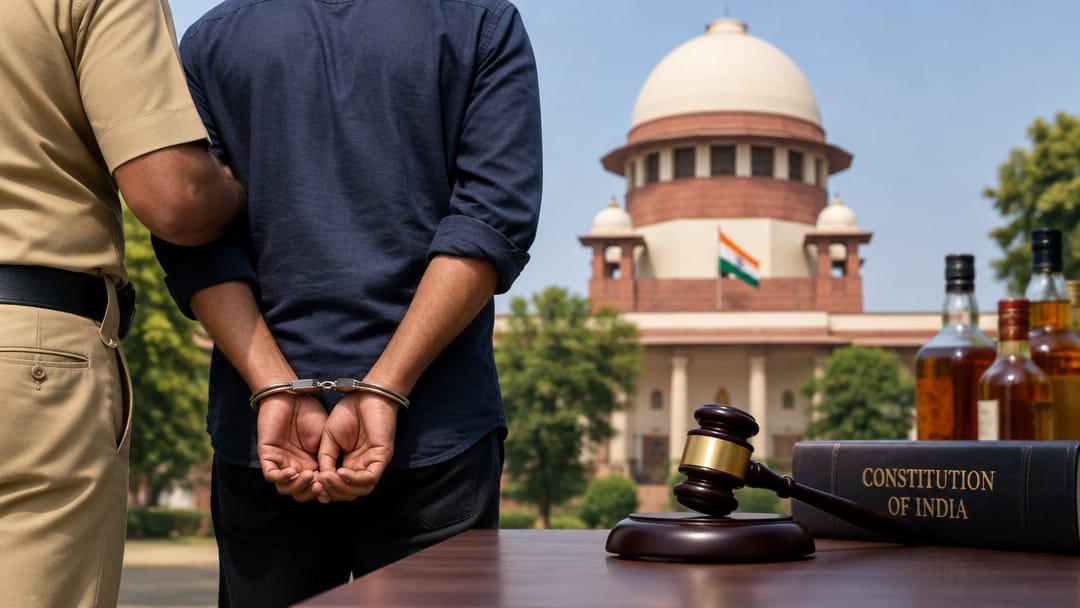
The Supreme Court validated the arrest procedure used by Andhra Pradesh investigators in a liquor scam case, holding that prior notice before arrest is not constitutionally mandatory when the arresting authority has reasonable grounds to believe the person may abscond or obstruct the investigation. The ruling reaffirms that personal liberty under Article 21 must be balanced against legitimate state interest in effective criminal investigation, provided procedural safeguards under the CrPC are observed.
02 Understand
Why it matters
This ruling engages the central tension in Indian constitutional law between Article 21 (right to life and personal liberty) and the state's power to arrest. The Supreme Court has consistently held since Maneka Gandhi v. Union of India (1978) that any procedure depriving a person of liberty must be fair, just, and reasonable — not merely formally prescribed by law. However, the Court has never held that advance notice is a constitutional precondition to arrest.
The governing framework draws from D.K. Basu v. State of West Bengal (1997), which laid down eleven binding guidelines for arrest and detention (identification memo, arrest memo, right to inform a relative, medical examination, etc.) without requiring pre-arrest notice. Joginder Kumar v. State of UP (1994) added that arrest must be justified by necessity, not mere power.
In the liquor investigation context, the Court applied the proportionality test: the limitation on liberty is valid if (i) it is backed by law, (ii) it pursues a legitimate state aim, and (iii) the means are proportionate to that aim. The absence of prior notice does not violate Article 21 when the investigation involves economic offences where flight risk and evidence destruction are real concerns. This is consistent with Arnesh Kumar v. State of Bihar (2014), which restricted mechanical arrests but did not require prior notice. The ruling reconfirms that procedural validity, not advance notice, is the constitutional benchmark.
Remember + Why it matters
The key recall facts and exact examiner angle for CLAT PG are in the Crux app.
01
Key figure and date from this topic
02
Specific number or threshold to remember
03
Policy or regulatory implication
Read + Understand free forever · 30-day free trial