01 Read
What happened
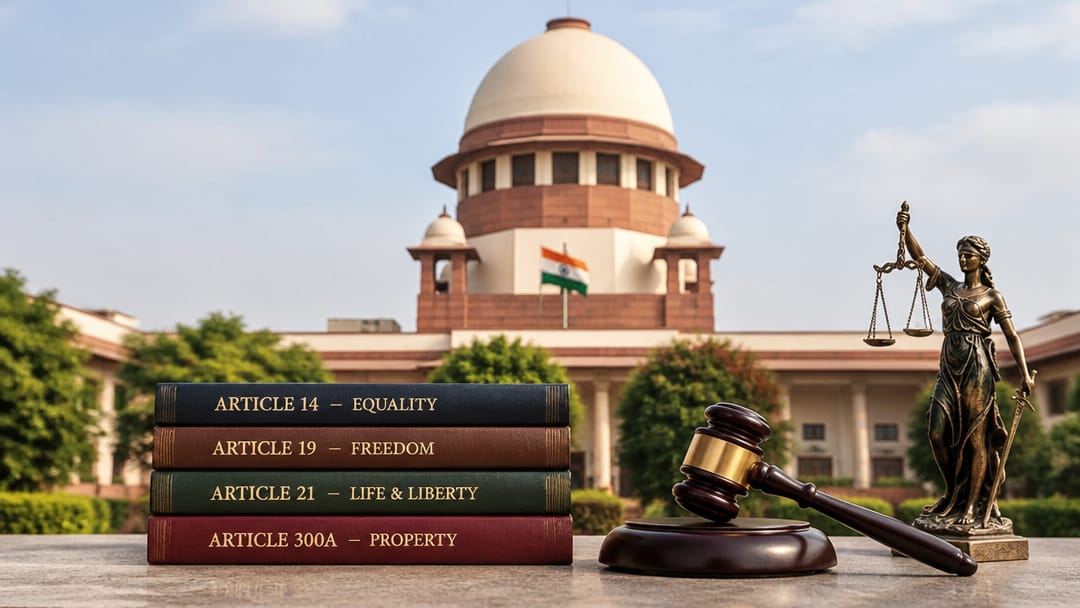
The Supreme Court of India delivered several landmark constitutional law judgments in the second half of 2025, shaping the interpretation of Articles 14, 19, 21, and 300A. The rulings refined the tests for reasonable classification, deprivation of liberty, procedural fairness, and compulsory acquisition of property without compensation. These judgments are part of an ongoing series cataloguing constitutional evolution and are directly relevant for aspirants preparing for CLAT PG and UPSC CSE.
02 Understand
Why it matters
India's constitutional rights jurisprudence evolves primarily through Supreme Court judgments. The four articles most frequently litigated — Art 14 (equality), Art 19 (freedoms), Art 21 (life and liberty), and Art 300A (property) — each carry a distinct doctrinal architecture that the Court refines with each ruling.
Art 14 prohibits arbitrary state action. The Court applies the 'reasonable classification' test: a classification must have an intelligible differentia and a rational nexus with the object of the law. Post-Maneka Gandhi (1978), the Court also reads Art 14 as requiring procedural fairness wherever the state acts.
Art 19 protects six freedoms (speech, assembly, movement, etc.) subject to 'reasonable restrictions' under clauses (2)–(6). The Court applies a proportionality standard: the restriction must be proportionate to the legitimate aim pursued.
Art 21 has expanded from a narrow 'procedure established by law' guarantee to a substantive right after Maneka Gandhi, encompassing the right to health, environment, livelihood, dignity, and speedy trial. The test now demands that any procedure depriving life or liberty be fair, just, and reasonable.
Art 300A, inserted by the 44th Amendment (1978), protects against deprivation of property except by 'authority of law.' The Supreme Court has progressively held that this requires not just legal authority but a fair and reasonable process, including notice, hearing, and compensation where applicable.
The 2025 rulings reportedly advance each of these doctrines — making them prime material for passage-based questions where the examiner will test whether you can apply the principle stated in the passage to a novel fact situation.
Remember + Why it matters
The key recall facts and exact examiner angle for UPSC CSE are in the Crux app.
01
Key figure and date from this topic
02
Specific number or threshold to remember
03
Policy or regulatory implication
Read + Understand free forever · 30-day free trial