01 Read
What happened
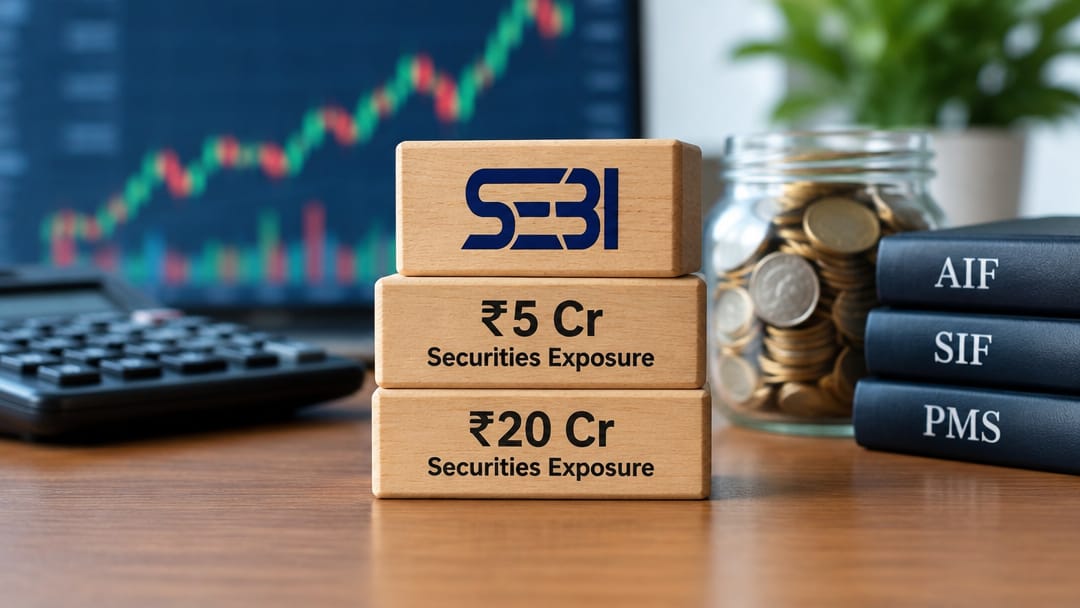
SEBI has eased accredited investor norms for participants in Alternative Investment Funds, Specialised Investment Funds, and Portfolio Management Services. Two new eligibility criteria based on securities market exposure — ₹5 crore and ₹20 crore thresholds — have been introduced alongside existing income and net-worth tests. Accreditation will now be valid for three years. The move widens access to sophisticated investment products by allowing market-experienced investors to qualify without meeting only traditional wealth benchmarks.
02 Understand
Why it matters
An accredited investor is a category of sophisticated investor deemed capable of bearing higher financial risk and understanding complex products, and therefore granted access to lightly regulated instruments like AIFs (minimum ₹1 crore commitment), PMS (minimum ₹50 lakh), and the newly created SIF (Specialised Investment Fund). Previously, accreditation relied primarily on income or net-worth criteria — for example, an individual needed annual income above ₹2 crore or net worth above ₹7.5 crore (with at least ₹3.75 crore in financial assets).
SEBI's new circular introduces a parallel track: investors with demonstrated exposure to securities markets — ₹5 crore for certain categories and ₹20 crore for others — can now qualify as accredited investors. This is significant because it recognises market participation and experience as a proxy for sophistication, not just accumulated wealth.
The three-year validity period for accreditation adds a fresh regulatory parameter — after three years, investors must reapply, ensuring the status reflects current financial standing rather than a one-time snapshot.
For SEBI Grade A aspirants, this circular sits at the intersection of investor protection and market access — a core regulatory tension SEBI navigates. Knowing the precise thresholds (₹5 crore, ₹20 crore), the instruments covered (AIF, SIF, PMS), the validity window (3 years), and the accreditation body framework is essential, as the examiner has consistently tested exact numbers and institutional mechanics in this domain.
Remember + Why it matters
The key recall facts and exact examiner angle for SEBI Grade A are in the Crux app.
01
Key figure and date from this topic
02
Specific number or threshold to remember
03
Policy or regulatory implication
Read + Understand free forever · 30-day free trial