01 Read
What happened
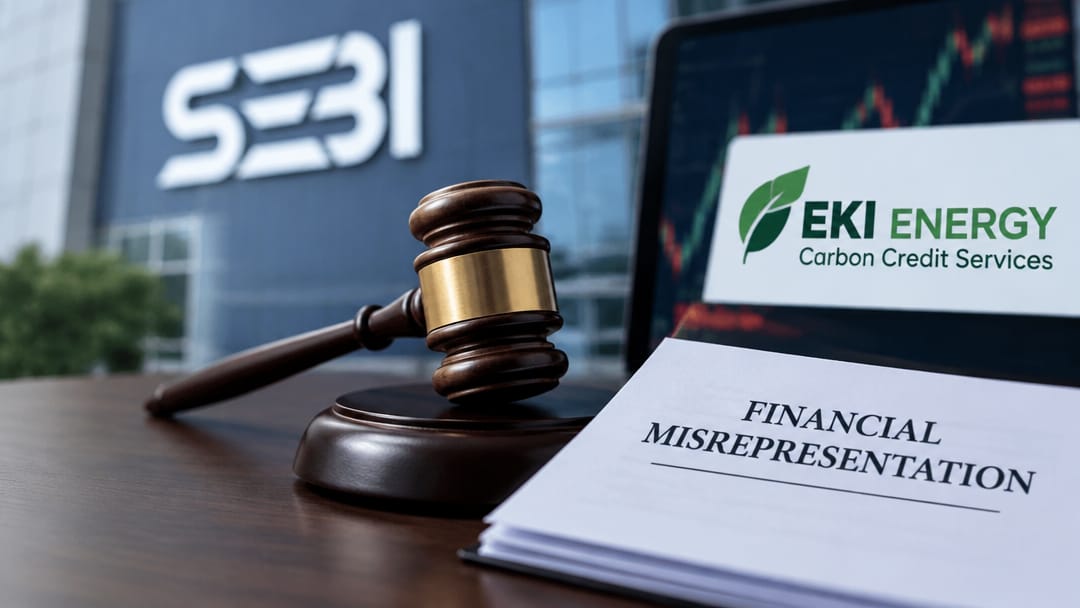
SEBI has barred EKI Energy Services Ltd and its Managing Director Manish Kumar Dabkara from the securities market for two months and 12 months respectively, citing financial misrepresentation. The regulator also imposed a monetary penalty on both entities. EKI Energy, a carbon credit services company, was found to have misrepresented its financial statements, misleading investors. The action invokes SEBI's powers under the SEBI Act and LODR Regulations to protect market integrity and investor interests.
02 Understand
Why it matters
This order tests two intersecting pillars of securities law: SEBI's enforcement powers and the liability of key managerial personnel for disclosure violations.
SEBI's power to bar entities from the securities market flows from Section 11 and Section 11B of the SEBI Act, 1992, which empower the Board to issue directions in the interest of investors and the securities market. A 'debarment' or 'restraint order' is distinct from a mere penalty — it prevents the entity from buying, selling, or dealing in securities during the ban period.
The LODR (Listing Obligations and Disclosure Requirements) Regulations, 2015 mandate that listed companies accurately disclose financial statements. Misrepresentation of financials violates Regulation 4(2)(f) (fair disclosure) and Regulation 33 (financial results). SEBI can act against both the company and its officers in default — here, the MD was held personally liable, which is a critical principle the examiner tests.
The differential penalty — 2 months for the company, 12 months for the MD — reflects SEBI's practice of imposing stricter personal accountability on key managerial personnel who sign off on disclosures. This mirrors the 'officer in default' concept under the Companies Act.
For SEBI Grade A aspirants, the operative legal hooks are Section 11B (directions), Section 15HA (penalty for fraudulent/unfair trade practices), and the LODR framework. The principle that a regulator can impose differentiated sanctions on an entity and its officer simultaneously is a favourite examiner angle.
SEBI's power to bar entities from the securities market flows from Section 11 and Section 11B of the SEBI Act, 1992, which empower the Board to issue directions in the interest of investors and the securities market. A 'debarment' or 'restraint order' is distinct from a mere penalty — it prevents the entity from buying, selling, or dealing in securities during the ban period.
The LODR (Listing Obligations and Disclosure Requirements) Regulations, 2015 mandate that listed companies accurately disclose financial statements. Misrepresentation of financials violates Regulation 4(2)(f) (fair disclosure) and Regulation 33 (financial results). SEBI can act against both the company and its officers in default — here, the MD was held personally liable, which is a critical principle the examiner tests.
The differential penalty — 2 months for the company, 12 months for the MD — reflects SEBI's practice of imposing stricter personal accountability on key managerial personnel who sign off on disclosures. This mirrors the 'officer in default' concept under the Companies Act.
For SEBI Grade A aspirants, the operative legal hooks are Section 11B (directions), Section 15HA (penalty for fraudulent/unfair trade practices), and the LODR framework. The principle that a regulator can impose differentiated sanctions on an entity and its officer simultaneously is a favourite examiner angle.
Remember + Why it matters
The key recall facts and exact examiner angle for RBI Grade B are in the Crux app.
01
Key figure and date from this topic
02
Specific number or threshold to remember
03
Policy or regulatory implication
Read + Understand free forever · 30-day free trial