01 Read
What happened
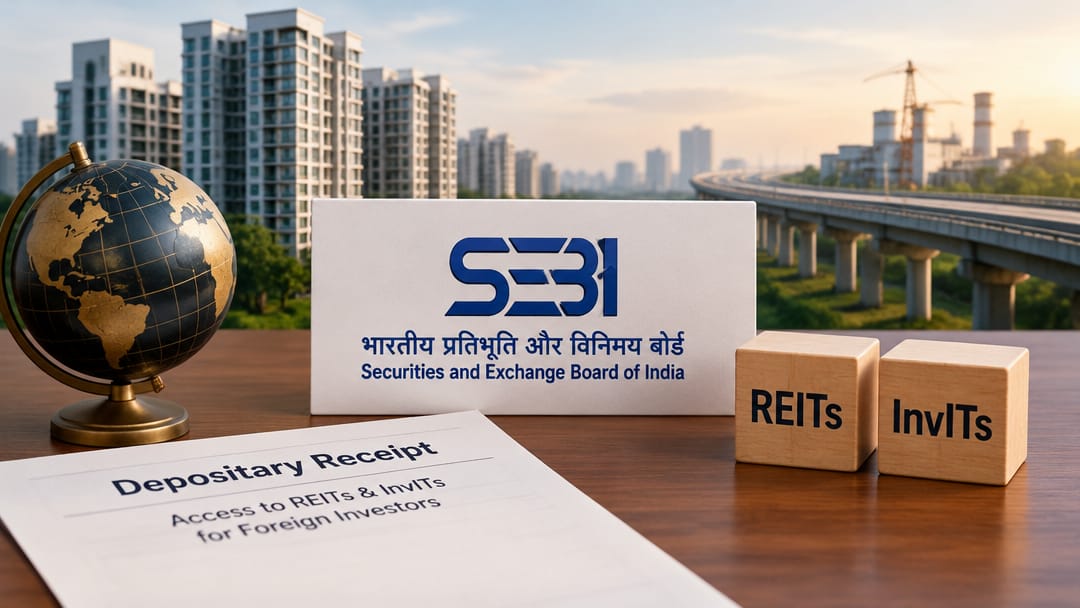
SEBI issued a depositary receipts framework on November 2, 2026, allowing foreign investors to purchase units of Real Estate Investment Trusts and Infrastructure Investment Trusts through depositary receipts listed abroad. The move extends the existing depositary receipt mechanism — previously available for equity shares — to REIT and InvIT units, broadening the investor base for these instruments and deepening India's capital markets by channelling foreign capital into real estate and infrastructure sectors.
02 Understand
Why it matters
Depositary receipts (DRs) are negotiable financial instruments issued by a foreign depositary bank representing ownership of a specified number of underlying securities held in the home country. Indian companies have long used American Depositary Receipts (ADRs) and Global Depositary Receipts (GDRs) to raise foreign capital. SEBI's new framework now extends this mechanism to REITs and InvITs.
REITs pool capital to own income-generating real estate (offices, malls, warehouses) and distribute at least 90% of net distributable cash flows to unit-holders. InvITs do the same for infrastructure assets — roads, power lines, pipelines. Both trade on Indian stock exchanges and are regulated by SEBI.
The DR route matters because many foreign institutional investors face regulatory or mandate-based restrictions on directly investing in Indian markets. By buying DRs on a foreign exchange, they gain economic exposure to REIT/InvIT units without navigating direct FPI registration. For India, this widens the capital pool available to fund real estate and infrastructure projects — both priority sectors — without repatriating equity control.
For exam purposes, the key distinction is that DRs are not the underlying instrument; they are certificates representing the underlying units held by a custodian in India. The DR holder's rights (dividends, distributions) flow through the depositary arrangement. SEBI is the primary regulator for both the underlying REITs/InvITs and the DR framework in India.
REITs pool capital to own income-generating real estate (offices, malls, warehouses) and distribute at least 90% of net distributable cash flows to unit-holders. InvITs do the same for infrastructure assets — roads, power lines, pipelines. Both trade on Indian stock exchanges and are regulated by SEBI.
The DR route matters because many foreign institutional investors face regulatory or mandate-based restrictions on directly investing in Indian markets. By buying DRs on a foreign exchange, they gain economic exposure to REIT/InvIT units without navigating direct FPI registration. For India, this widens the capital pool available to fund real estate and infrastructure projects — both priority sectors — without repatriating equity control.
For exam purposes, the key distinction is that DRs are not the underlying instrument; they are certificates representing the underlying units held by a custodian in India. The DR holder's rights (dividends, distributions) flow through the depositary arrangement. SEBI is the primary regulator for both the underlying REITs/InvITs and the DR framework in India.
Remember + Why it matters
The key recall facts and exact examiner angle for UPSC CSE are in the Crux app.
01
Key figure and date from this topic
02
Specific number or threshold to remember
03
Policy or regulatory implication
Read + Understand free forever · 30-day free trial