01 Read
What happened
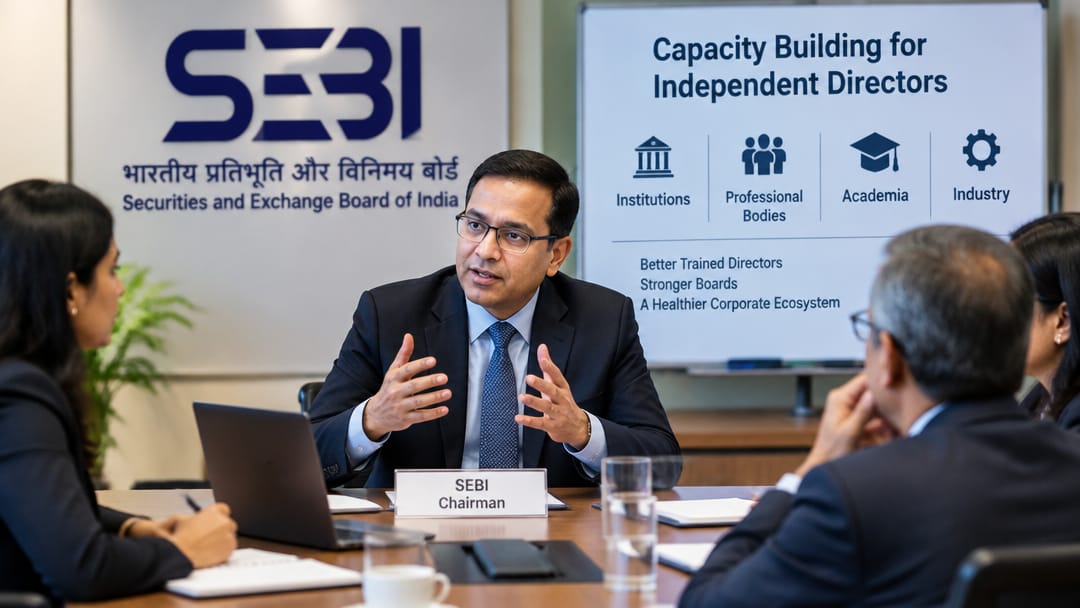
SEBI Chairman Tuhin Kanta Pandey announced that the regulator is exploring a capacity-building network for independent directors, drawing on institutions, professional bodies, academia, and industry. The initiative aims to address skill gaps among independent directors of listed companies, who are central to board-level oversight. SEBI sees structured training as essential to making independent directors genuinely effective rather than nominally compliant with the Companies Act and SEBI's Listing Obligations and Disclosure Requirements Regulations.
02 Understand
Why it matters
Independent directors (IDs) are the cornerstone of corporate governance in listed companies. Under the Companies Act, 2013 (Section 149), every listed company must have at least one-third of its board as independent directors. SEBI's LODR Regulations 2015 add further requirements: the top 1,000 listed entities by market capitalisation must have at least one woman independent director, and the chairperson of the audit committee must be an independent director.
Despite these structural mandates, a persistent criticism is that IDs often lack domain expertise or the confidence to challenge management, reducing them to rubber stamps. SEBI's proposed capacity-building network directly addresses this 'compliance vs. effectiveness' gap.
The regulatory framework already requires IDs to complete an online proficiency self-assessment test conducted by the Indian Institute of Corporate Affairs (IICA) under the Companies (Appointment and Qualification of Directors) Rules, 2014. IDs must appear for this test within one year of inclusion in the databank. SEBI's proposed network would go further — creating an ecosystem of continuous, multi-stakeholder learning rather than a one-time test.
For exam purposes, the key distinction is between the statutory minimum (IICA databank + self-assessment) and the proposed SEBI initiative (multi-institution capacity-building network). The examiner will test whether aspirants know which body administers the existing ID databank, the tenure limits for IDs (two consecutive terms of five years each), and the cooling-off period (three years) before re-appointment.
Remember + Why it matters
The key recall facts and exact examiner angle for SEBI Grade A are in the Crux app.
01
Key figure and date from this topic
02
Specific number or threshold to remember
03
Policy or regulatory implication
Read + Understand free forever · 30-day free trial