01 Read
What happened
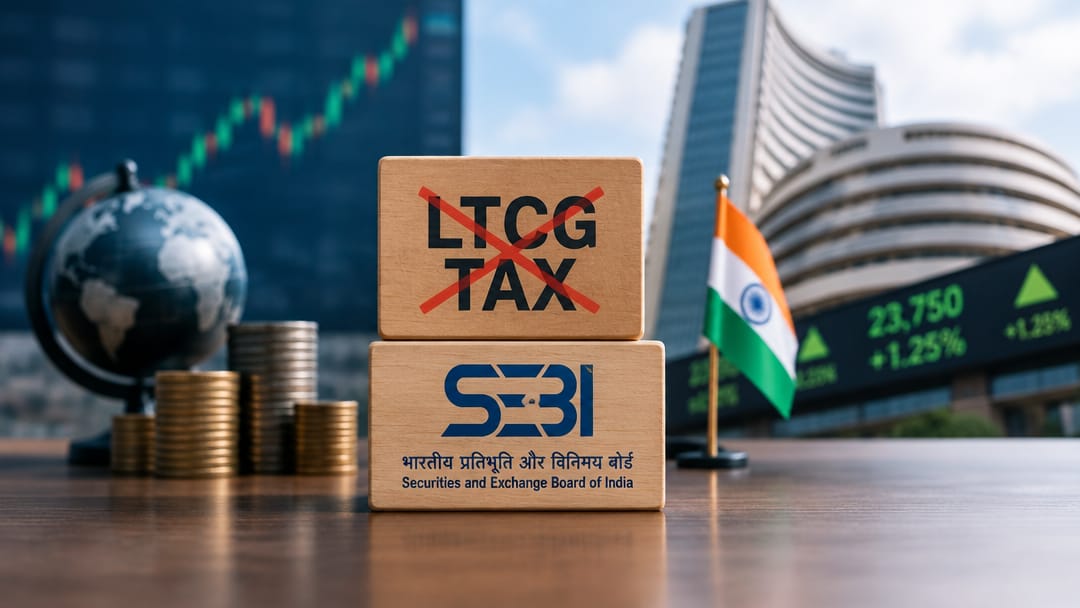
SEBI has recommended that the government eliminate the long-term capital gains tax levied on foreign institutional investors, according to a Reuters report. The proposal aims to make Indian equity markets more attractive to overseas capital. However, market experts caution that tax relief alone is insufficient to reverse sustained FII outflows, pointing to broader structural factors including global risk appetite, dollar strength, and concerns about India's earnings growth trajectory as equally decisive determinants.
02 Understand
Why it matters
Long-term capital gains (LTCG) tax on equities was reintroduced in India through the Union Budget 2018, imposing a 10% tax on gains exceeding ₹1 lakh from listed equity shares held for more than one year. Prior to 2018, such gains were fully exempt. The Finance Act 2024 revised the LTCG rate upward to 12.5%, removing the earlier indexation benefit for certain asset classes.
Foreign Institutional Investors (FIIs) and Foreign Portfolio Investors (FPIs) are particularly sensitive to tax treatment because they compare after-tax returns across competing emerging markets. When India raised or maintained LTCG, it reduced India's relative attractiveness compared to jurisdictions with no such levy.
SEBI's role here is notable: as the capital markets regulator, SEBI does not set tax policy — that is the Finance Ministry's domain — but it can make formal recommendations to the government, particularly when tax structures affect market depth and liquidity. This is an example of SEBI exercising its advisory function rather than its regulatory or enforcement function.
Experts who disagree with the sufficiency of tax cuts point to non-tax drivers of FII behaviour: US Federal Reserve rate expectations, the strength of the US dollar, relative valuations, and India-specific earnings disappointments. This debate — structural vs. tax-driven outflows — is a classic exam theme connecting capital market regulation to macroeconomic policy.
Foreign Institutional Investors (FIIs) and Foreign Portfolio Investors (FPIs) are particularly sensitive to tax treatment because they compare after-tax returns across competing emerging markets. When India raised or maintained LTCG, it reduced India's relative attractiveness compared to jurisdictions with no such levy.
SEBI's role here is notable: as the capital markets regulator, SEBI does not set tax policy — that is the Finance Ministry's domain — but it can make formal recommendations to the government, particularly when tax structures affect market depth and liquidity. This is an example of SEBI exercising its advisory function rather than its regulatory or enforcement function.
Experts who disagree with the sufficiency of tax cuts point to non-tax drivers of FII behaviour: US Federal Reserve rate expectations, the strength of the US dollar, relative valuations, and India-specific earnings disappointments. This debate — structural vs. tax-driven outflows — is a classic exam theme connecting capital market regulation to macroeconomic policy.
Remember + Why it matters
The key recall facts and exact examiner angle for SEBI Grade A are in the Crux app.
01
Key figure and date from this topic
02
Specific number or threshold to remember
03
Policy or regulatory implication
Read + Understand free forever · 30-day free trial