01 Read
What happened
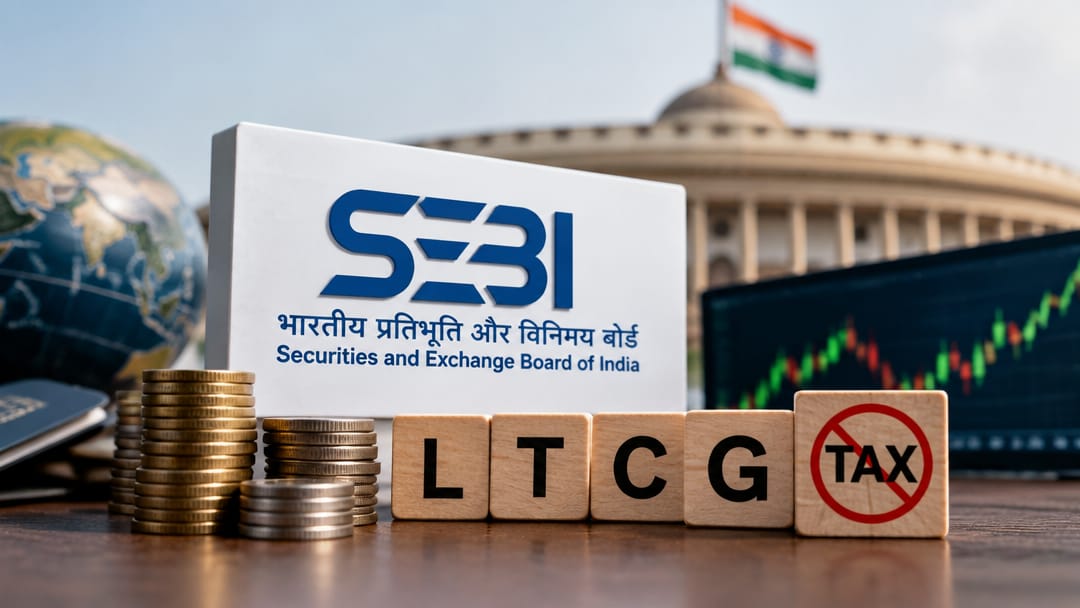
SEBI has recommended that the government remove the 12.5% long-term capital gains tax levied on foreign investors in Indian equities, according to two sources. The regulator also proposed that domestic mutual fund investors switching between schemes after holding units for over a year should not face a taxable event. The pre-budget recommendations are non-binding. Foreign investors have sold a record $31 billion in Indian stocks this year as the Nifty 50 has underperformed emerging market peers.
02 Understand
Why it matters
Long-term capital gains (LTCG) tax is levied on profits from selling assets held beyond a specified period. In India, securities held for more than one year attract LTCG tax at 12.5%, while short-term capital gains (STCG) on securities held under a year are taxed at 20%. Foreign Portfolio Investors (FPIs) also pay Securities Transaction Tax (STT) and withholding taxes on dividends, making India's transaction cost structure among the highest globally.
SEBI's recommendation is significant because it exposes a structural tension: the regulator's mandate is market development, but tax policy rests entirely with the Finance Ministry. SEBI's pre-budget representations are advisory and non-binding — the government retains final authority.
The proposal for mutual fund switchers addresses a behavioural barrier: investors who want to rebalance portfolios are currently taxed on notional gains when switching schemes, discouraging active portfolio management. Exempting switches (after one-year holding) from LTCG would treat intra-mutual-fund movement as a continuation of investment rather than a disposal.
The backdrop matters: the Nifty 50 has fallen 4.8% over two years while the MSCI Emerging Market index rose 40%. FPI outflows of $31 billion are a record. India's mutual fund AUM stands at ₹82.6 trillion, with ₹30 billion flowing in monthly via SIPs. SEBI's move is part of a broader effort to reduce the cost of capital for equity markets and retain foreign capital.
Remember + Why it matters
The key recall facts and exact examiner angle for UPSC CSE are in the Crux app.
01
Key figure and date from this topic
02
Specific number or threshold to remember
03
Policy or regulatory implication
Read + Understand free forever · 30-day free trial