01 Read
What happened
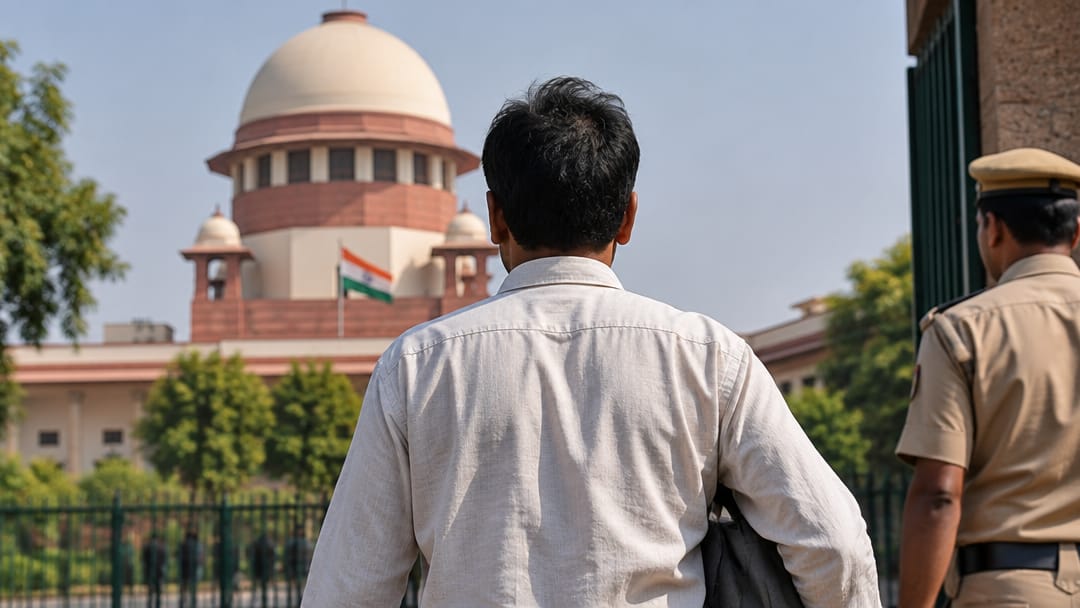
The Supreme Court ordered the Uttar Pradesh government to pay ₹6 lakh compensation to a man who spent six years in prison as an undertrial before being acquitted. The Court criticised UP Police for shoddy investigation, remarking that the force needs education in proper investigation methods. The ruling reinforces the constitutional right to speedy trial and the State's liability for wrongful incarceration under Article 21 of the Indian Constitution.
02 Understand
Why it matters
This judgment sits at the intersection of three important legal principles that CLAT PG and UPSC CSE both test repeatedly.
First, the right to speedy trial. Though not explicitly enumerated in Part III, the Supreme Court in Hussainara Khatoon v. State of Bihar (1979) read it into Article 21 as an essential component of the right to life and personal liberty. An undertrial who spends years in custody without conviction is a victim of this right's violation.
Second, State liability for custodial wrongs. When the State's machinery — police or prosecution — causes wrongful detention, the State cannot escape liability by pointing to the eventual acquittal as vindication. The Court's power to award compensation under Article 32 (and Article 226 at High Court level) for violation of fundamental rights was firmly established in Rudal Shah v. State of Bihar (1983), the landmark case where the SC awarded monetary compensation for illegal detention for the first time.
Third, the investigative quality obligation. The Court's remark that UP Police 'need education in investigation' signals judicial impatience with faulty chargesheet-filing that leads to prolonged undertrial detention. Under the CrPC (now BNSS 2023), Section 173 governs the police report/chargesheet. A defective investigation that results in wrongful imprisonment engages both the officer's accountability and the State's vicarious liability.
For CLAT PG, the passage-MCQ format will likely present the Rudal Shah or Hussainara Khatoon principle and ask you to apply it to a new fact pattern involving an acquitted undertrial seeking compensation.
Remember + Why it matters
The key recall facts and exact examiner angle for UPSC CSE are in the Crux app.
01
Key figure and date from this topic
02
Specific number or threshold to remember
03
Policy or regulatory implication
Read + Understand free forever · 30-day free trial