01 Read
What happened
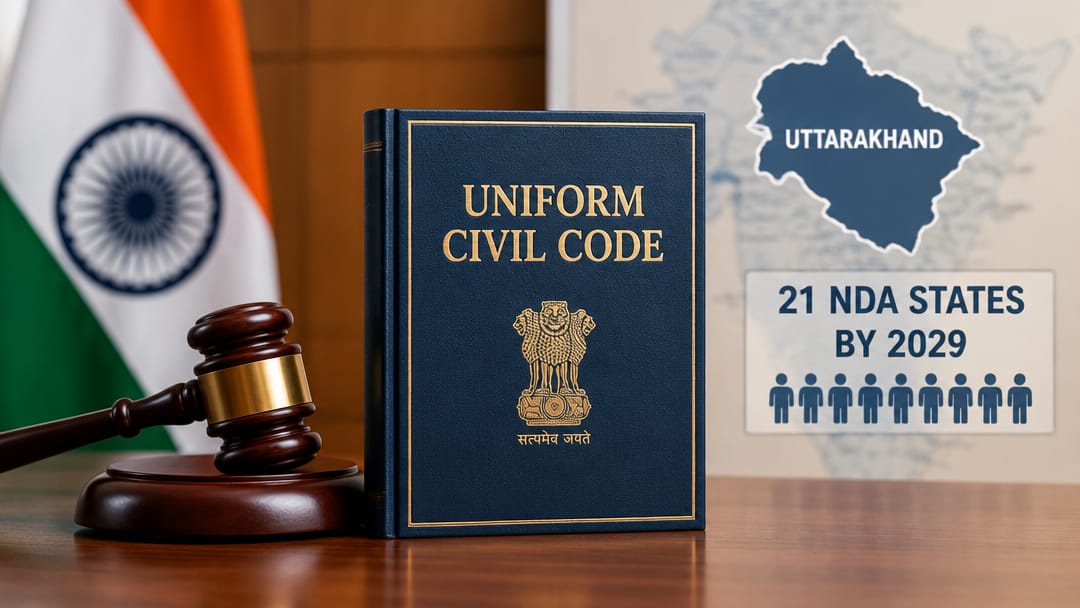
Uttarakhand became the first state to enact a Uniform Civil Code in 2024, replacing personal laws governing marriage, divorce, inheritance, and adoption for all residents except Scheduled Tribes. The BJP-led NDA government has set a target of implementing UCC across 21 states by 2029. The UCC is directed by Article 44 of the Constitution as a Directive Principle of State Policy, making it aspirational but not judicially enforceable as a fundamental right.
02 Understand
Why it matters
The Uniform Civil Code refers to a single set of civil laws governing personal matters — marriage, divorce, maintenance, inheritance, and adoption — applicable to all citizens regardless of religion. Currently, India operates under religion-specific personal laws: the Hindu Marriage Act, Muslim Personal Law, Indian Christian Marriage Act, and Parsi Marriage and Divorce Act, among others.
Article 44 of the Constitution places UCC in Part IV as a Directive Principle of State Policy (DPSP). DPSPs are non-justiciable — a citizen cannot go to court demanding UCC enforcement — but courts have repeatedly nudged Parliament toward it. The Supreme Court first called for UCC in Shah Bano (1985) and again in Sarla Mudgal (1995), observing that personal law conflicts produce unjust outcomes, especially for women.
The constitutional tension is critical for CLAT PG: UCC intersects with Article 25 (freedom of religion), Article 26 (right to manage religious affairs), and Article 14 (equality). Minority communities argue personal law is part of religious identity protected under Articles 25–26. Proponents argue inequality within personal laws — especially in Muslim divorce, Hindu inheritance, and Christian adoption — violates Article 14.
Uttarakhand's 2024 UCC Act is significant because it is the first sub-national implementation. It exempts Scheduled Tribes — a deliberate carve-out that itself raises Article 14 questions about differential treatment. For CLAT PG, the examiner will test whether you understand why a DPSP cannot be directly enforced, how personal law interacts with fundamental rights, and what the courts have said about the state's obligation.
Remember + Why it matters
The key recall facts and exact examiner angle for CLAT PG are in the Crux app.
01
Key figure and date from this topic
02
Specific number or threshold to remember
03
Policy or regulatory implication
Read + Understand free forever · 30-day free trial