01 Read
What happened
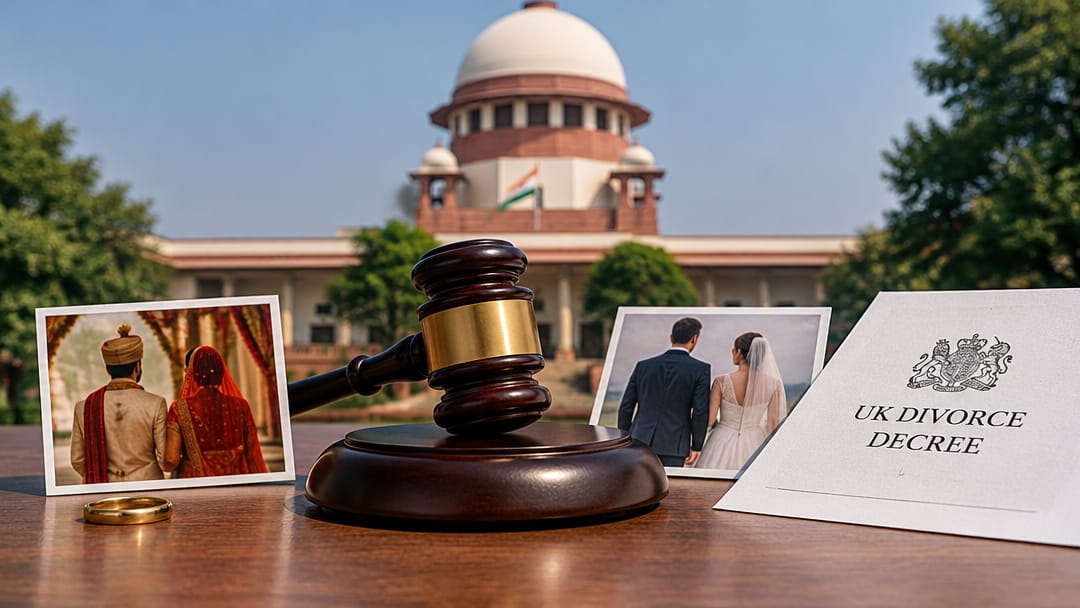
The Supreme Court ruled that a foreign divorce decree obtained on grounds of irretrievable breakdown of marriage does not protect a husband married under Indian law from prosecution for bigamy. The husband, a UK citizen, had remarried after securing a UK court divorce, arguing the foreign decree dissolved the first marriage. The Court rejected this defence, holding Indian matrimonial law governs the validity of the first marriage. His parents, also named in the complaint, were cleared of charges.
02 Understand
Why it matters
This ruling engages two intersecting doctrines: the recognition of foreign judgments under private international law and the criminal liability for bigamy under Section 494 IPC (now Section 82 BNS).
Under Section 13 of the Code of Civil Procedure, 1908, a foreign judgment is conclusive between parties except where it has not been pronounced by a court of competent jurisdiction, was obtained by fraud, refuses to recognise Indian law where it should apply, or is contrary to natural justice or public policy. Crucially, grounds for divorce not recognised under the applicable personal law in India — such as 'irretrievable breakdown,' which is not yet a statutory ground under the Hindu Marriage Act, 1955 — can render a foreign decree unenforceable in India.
The Supreme Court's position builds on Y. Narasimha Rao v. Y. Venkata Lakshmi (1991), where the Court held that a foreign decree dissolving a Hindu marriage would be recognised only if it was granted on a ground available under the Hindu Marriage Act. A decree on a ground not so available is void as against Indian public policy.
For bigamy under Section 494 IPC, the offence requires that the first marriage subsists. If the foreign divorce is not recognised by Indian courts, the first marriage legally continues, making the second marriage bigamous. The husband's UK citizenship and the UK court's jurisdiction do not override this principle when the first marriage was solemnised in India under Indian law.
The acquittal of the parents reflects the settled criminal law position that in-laws cannot be held vicariously liable for bigamy unless active participation is proven.
Remember + Why it matters
The key recall facts and exact examiner angle for CLAT PG are in the Crux app.
01
Key figure and date from this topic
02
Specific number or threshold to remember
03
Policy or regulatory implication
Read + Understand free forever · 30-day free trial